Fill each gap with the most appropriate option from the list provided.
The reason why he was not offered admission was ...... his results could not be found?
that
when
owing to
because
Explanation
No explanation available
Video Explanation
No video available
Post your Contribution
Discussions (18)


The correct answer is D. "because." So the complete sentence would be: "The reason why he was not offered admission was because his results could not be found."
why so?
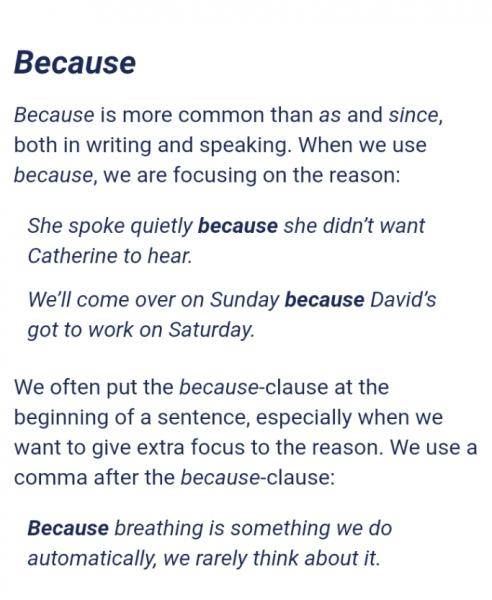
well the word "because" is used to introduce a reason or explanation for something. In this context, it explains why the person was not offered admission. The structure "because [reason]"
indicates a causal relationship between the reason given and the outcome. Therefore, "because" is the most appropriate option to fill the gap in the sentence.
now what makes option D the most appropriate option?
Option D, "because," is a better option than option A, "that," in this context because "because" directly introduces a reason or explanation for the situation described in the sentence.
now Let's compare the two:
Option D: "The reason why he was not offered admission was because his results could not be found."
Option A: "The reason why he was not offered admission was that his results could not be found."
While both options convey a similar meaning, "because" is more commonly used to introduce a reason or cause, making the sentence more concise and straightforward. "That" can sometimes introduce a subordinate clause, but it doesn't emphasize the cause-effect relationship as clearly as "because" does in this context. Therefore, "because" is generally preferred in casual or informal writing for clarity and directness.
my school pls make corrections

The correct answer is:
 A. that
Explanation:
The sentence is structured in a formal way, and "the reason why" is typically followed by "that" rather than "because" or other conjunctions.
Let's analyze the options:
A. that (Correct: "The reason why he was not offered admission was that his results could not be found.")
B. when  (Incorrect: "The reason when..." does not make sense.)
C. owing to (Incorrect: "The reason owing to..." is grammatically incorrect.)
D. because (Incorrect: "The reason because..." is redundant; "because" already implies a reason.)
Thus, the best choice is:
A. that.
Correct Sentence:
"The reason why he was not offered admission was that his results could not be found."
🧠 Why "that" is correct:
This is a classic grammar structure:
"The reason (why) ... was that ..."
You use "that" to introduce the explanation or cause of the reason. It fits perfectly after "was" to complete the sentence logically and grammatically.
Let’s quickly check why the others are wrong:
B. when → Wrong tense and meaning. It introduces time, not a reason.
C. owing to → It’s a preposition, and cannot follow "was" like that.
D. because → Doesn’t fit here. We don’t say "The reason was because..." — it’s ungrammatical. It’s actually a common mistake.
🧠 How to remember it forever:
When you see "The reason ... was ...", the best follow-up is always "that" — not "because" or "owing to."

the key to success in english is to focus your mind on the concept rather than the onset

