Fill in the gap(s) with the most appropriate option from the list following the gap(s).
He is one of those who ....... in my school?
teaches
is teaching
are teaching
teach
Explanation
Video Explanation
No video available
Post your Contribution
Discussions (16)

but remember whenever relative pronouns like who whose which that is used, d noun bf it will be considered
"those" is in front of Who in d sentence
and considering it, it's plural and should take plural verb(teach) not teaches ('es signifies singular).
But if who is not there it supposed to be singular...
so option D is correct, considering WHO

This is wrong
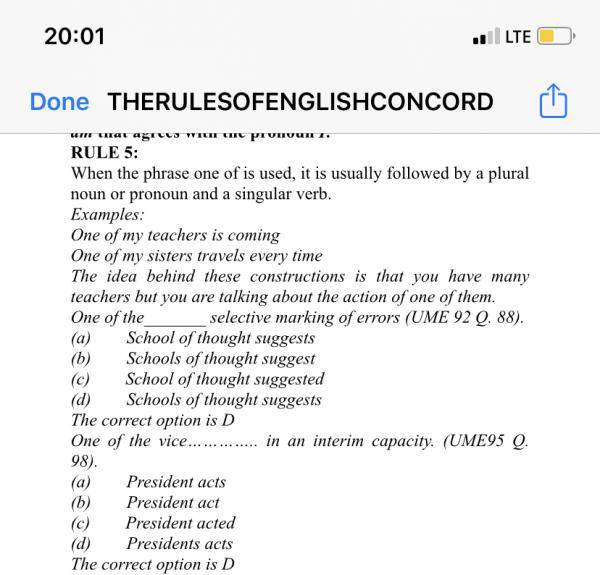
The rule of - One of states that it should be followed by a plural noun and a singular verb
The singular verb is TEACHES not TEACH
Okay?🙂

In the sentence "He is one of those who teach in my school", using "teaches" instead of "teach" would be incorrect.
Why "Teaches" is incorrect
The reason is that the relative clause "who teaches" would imply that "he" is the only one teaching, whereas "who teach" indicates that he is one of multiple people teaching.
Correct usage
- "He is one of those who teach in my school" (multiple people teach)
- "He is the one who teaches in my school" (only one person teaches)
the answer is A.
"One of" is followed by a singular verb
"Teaches" is the singular verb while "teach" is the plural verb.
The sentence "He is one of those who teach in my school" is grammatically correct.
Explanation
The sentence uses the correct form of the verb "teach" in the relative clause "who teach", which agrees with the plural noun "those".
Breakdown
- "He" is the subject of the sentence.
- "is one of those" is a phrase indicating that he is part of a group.
- "who teach" is a relative clause describing the group.
- "in my school" is a prepositional phrase providing additional information.
The sentence is structured correctly and conveys a clear meaning.
The most appropriate option is D. teach.
Here's why:
The phrase "one of those who" introduces a relative clause that refers back to the plural noun "those." Therefore, the verb in the relative clause should also be plural.
So, the complete sentence is: "He is one of those who teach in my school."
In the sentence "He is one of those who teach in my school," the subject of the verb "teach" is "who." In this grammatical construction, "who" refers back to the plural pronoun "those." Therefore, the verb that follows "who" must agree in number with "those," which is plural. Hence, we use the base form of the verb, "teach."
Think of it this way: the relative clause "who teach in my school" is describing the group of "those" people. Since "those" is plural, the verb describing their action ("teach") is also in the plural form (which happens to be the base form of the verb).
So, while "teach" itself doesn't have an "-s" ending to make it plural like a noun, its use in the sentence is grammatically plural because it agrees with the plural pronoun "those."

