full employment of resources
unemployment
inflation
full employment of factors of production
Explanation
Video Explanation
No video available
Post your Contribution
Discussions (4)

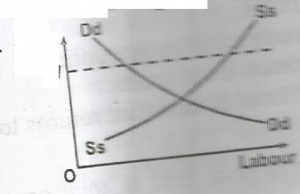
the answer is unemployment, usually when the minimum price is above equilibrium price suppliers will supply more which will lead to excess supply. In the same context since minimum wage rate is above equilibrium there will be an exess supply of labour with a lower demand for it, hence more unemployment
Minimum Wage is always above the Equilibrium Wage. This directly means EMPLOYERS will pay more, while EMPLOYEES (workers, i.e, labour) will earn more.
This will lead to
1. Cost Push Inflation: The increase in the cost of production factor (i.e, labour).
2. Demand Pull Inflation: When workers earn more, they tend to spend more.
Thus, the correct answer is C. Inflation;
A. full employment of resources
B. unemployment
C. inflation
D. full employment of factors of production
14-05-23; 6:34pm
Minimum Wage is always above the Equilibrium Wage. This directly means that EMPLOYERS will pay more, while EMPLOYEES (workers, i.e, labour) will earn more.
This will lead to
1. Cost Push Inflation: The increase in the cost of production factor (i.e, labour).
2. Demand Pull Inflation: When workers earn more, they tend to spend more.
Thus, the correct answer is C. Inflation;
A. full employment of resources
B. unemployment
C. inflation
D. full employment of factors of production

