Which of the following can be deduced from the law of variable proportions when total output is rising?
MP is greater than AP
MP is less than AP
MP is equal to AP
MP is equal to zero
Explanation
No explanation available
Video Explanation
No video available
Post your Contribution
Discussions (4)

Leverage Edu
Search for:
Home /
Economics /
Law of Variable Proportion: Detailed Explanation
Law of Variable Proportion: Detailed Explanation
Team Leverage Edu
Updated on
Dec 17, 2021
5 minute read
17.4K views
10 shares
Law of Variable Proportion
Imagine, you are standing at your favourite ice cream parlour and eagerly waiting to gobble it up, and you start eating the scoops one after the other continuously. At first, your satisfaction level is at its highest peak and After having 3 or 4 scoops, your level is still increasing, but now at a diminishing rate. Eventually, a point will come when you will be almost close to being satisfied and full, there would be lesser chances for you to eat another scoop. This is exactly what the Law of Variable Proportion means. Being one of the most popular concepts in the field of Business Economics and Managerial Economics, here is an insightful blog to help you understand every aspect of the law.
Must Read: Types of Economy Explained
THIS BLOG INCLUDES:
What is the Law of Variable Proportions?
Assumptions
Terms to Remember
What are the Stages of Law of Variable Proportion?
Relation Between TP, MP and AP
Want Free Career Counselling?
Register here!
What is the Law of Variable Proportions?
The Law of Variable Proportions states that as the quantity of a factor is increased while keeping other factors constant, the Total Product (TP) first rises at an incremental rate, then at a decremental rate and lastly the total production begins to fall. In other words, as one of the factors in production makes some variation in its quantity, keeping all the other factors constant, the ratio between all the factors starts varying, which further influence the level of output.
Economics for UPSC
Assumptions
The law of variable proportion works under the following situations:
Constant State of Technology
The first assumption is that the state of technology given for the situation remains unchanged. In case, the technology gets improved, then the marginal product may rise rather than diminish.
Other Factors also remain fixed
This means that there should some inputs or factors given in a certain situation which should remain fixed in terms of their quantity. By changing the factor proportions, we can understand the effects on the output. However, the law would not work if all the factors are altered in proportions.
Possibility of Varying the Proportions of Factors
The third assumption is that the law can only work if there is the scope for varying proportions of factors as fixed proportions might not yield effective results.
Class 12 Economics: CBSE Course Structure
Class 12 Macroeconomics
Terms to Remember
Before we go ahead with a detailed explanation of the law, let us first understand the different terms that we will be using in this blog:
Terminologies Description
Production Function As we know, production implies
the transformation of physical inputs into
physical outputs. Therefore, the
production function explains the
interrelationship between the factor input and output.
Total Product (TP) Total Product (TP) is also known as total output.
Following varied values of a physical variable input
along with a fixed amount of input,
this process gives us the value of TP.
Average Product (AP) Average Product equals the Total Product (TP)
divided by the Total Number of Variable Inputs.
In other words, AP is the output per unit.
Marginal Product (MP) Marginal Product or output is derived
when the producer employs additional
units of inputs in variable factors.
Which further means, that it is a rate at which the TP rises.
How to Prepare for Competitive Exams?
What are the Stages of Law of Variable Proportion?
In order to understand this in detail, let us take an example. Imagine you own a land wherein you produce rice by employing more and more labour (variable factors). The table given below explains the situation further:
What are the Stages of Law of Variable Proportion?
3 Stages of Law of Variable Proportion
3 Stages of Law of Variable Proportion
In the above table and graph of the Law of Variable Proportions, you would notice that:
Up to 3 units of labour employed, the TP is rising at an increasing rate (2,6,12). This constitutes Stage 1 of the law, which is the Stage of Increasing Returns. Therefore, during the first stage, the TP curve increases significantly.
Beyond the 3rd unit of labour, the TP starts rising at a diminishing rate (12,16,18), which means the TP curve rises at a slower rate. This eventually makes the marginal product (MP) starting to fall. Constituting the second stage of the Law of Variable Proportion which is called the Stage of Diminishing Returns.
After the employment of 6 units of labour, the TP starts to fall, indicating the 3rd stage which is the Stage of Negative Returns. Even after employing 6 units of labour, it fails to yield the marginal product, that is when the MP comes to zero. Eventually, the TP curve starts sloping down and the marginal product goes to negative in the x-axis.
Economics Project for Class 12
Relation Between TP, MP and AP
Now that we know how all the 3 aspects behave in all the three stages of the Law of Variable Proportion, let us provide you with an insight on how these three factors are related to each other.
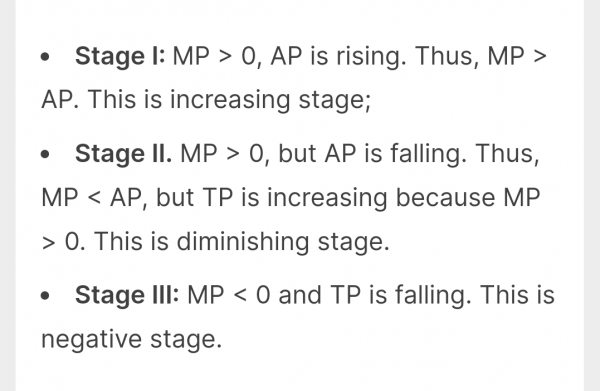
When TP increases at an increasing rate, the MP and AP also increase. However, at this stage, MP>AP
When TP increases at a decreasing rate, the MP and AP start to fall. When MP starts falling significantly and AP falls at a low rate, it means that now MP
Now that we know how all the 3 aspects behave in all the three stages of the Law of Variable Proportion, let us provide you with an insight on how these three factors are related to each other.
When TP increases at an increasing rate, the MP and AP also increase. However, at this stage, MP>AP
When TP increases at a decreasing rate, the MP and AP start to fall. When MP starts falling significantly and AP falls at a low rate, it means that now MP

