An experiment test of the Law of conservation of Mass is illustrated in the diagram. In practice, the flask is weighed before and after reaction between solutions X and Y. Which of the following pairs of solutions will be unsuitable for the experiments
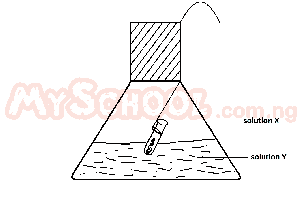
X = hydrochloric acid; Y = silver nitrate
X = barium chloride; Y = dilute sulphuric acid
X = hydrochloric acid; Y = sodium hydroxide
X = hydrochloric acid; Y = lead nitrate
X = hydrochloric acid; Y = sodium carbonate
Explanation
Video Explanation
No video available
Post your Contribution
Discussions (17)

Answer: E
If you have an open system such as a beaker, then material may be lost to the outside. If you react sodium carbonate with hydrochloric acid you will end up with less mass in the beaker. This clearly shows that it does not obey the LAW OF CONSERVATION OF MASS

Alright, let's figure out which pair of solutions wouldn't work for testing the Law of Conservation of Mass!
The Law of Conservation of Mass
This law says that in a closed system, the total mass of the reactants before a chemical reaction is equal to the total mass of the products after the reaction.
The Experiment
In this experiment, solutions X and Y are mixed in a closed flask. We need to find a pair that would let gas escape, making it seem like mass is lost.
Analyzing the Options
* A. X = hydrochloric acid; Y = silver nitrate: This makes a solid (precipitate) and a solution. No gas is produced.
* B. X = barium chloride; Y = dilute sulfuric acid: This also makes a solid (precipitate) and a solution. No gas is produced.
* C. X = hydrochloric acid; Y = sodium hydroxide: This makes salt and water. No gas is produced.
* D. X = hydrochloric acid; Y = lead nitrate: This makes a solid (precipitate) and a solution. No gas is produced.
* E. X = hydrochloric acid; Y = sodium carbonate: This makes a salt, water, AND carbon dioxide gas. The gas would escape, making it seem like mass is lost.
The Answer
The pair that would be unsuitable is E. X = hydrochloric acid; Y = sodium carbonate because it produces a gas that would escape from the flask, violating the principle of a closed system needed to accurately test mass conservation.

the law states that matter is not. Created nor destroyed meaning dat the same Mass before reaction is also constant after reaction buh co2 is produced in the reaction in option d which might escape rendering the Law null

Yes, the answer is D. This is because when Na2Co3 reacts with HCl produces CO2 gas which escapes into the air. Therefore the mass of the reactant is not equal to the mass of the product unlike the reaction in other options in which they are equal.


in verifying the law of conservation of mass the reactant must be able to give a ppt without giving off any gas



