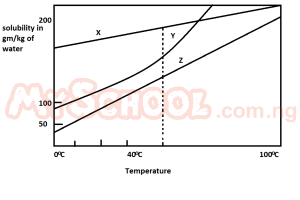
Consider the solubility curves of three salts X, Y and Z given in the diagram. If each solution of the salt contains 200 g, and is heated to 100\(^o\)C, which solution or solutions will deposit 100 g of the solute when suddenly cooled to 0\(^o\)C?
X only
Y only
Z only
X and Z
Y and Z
Explanation
Video Explanation
No video available
Post your Contribution
Discussions (21)

Yes,E I the answer.
Since the solubility curves I gramme or kilograme of Z and Y didn't exceed 100g,only X exceeded 100g from the curve, therefore Z and Y can deposit 100g..
Thanks

My School pls resolve the issue of the diagram not showing. It's being giving me a bad time
x yields 220-150=70
y yields 220-75=145
z yields 200-25=175
therefore the salts are y and z

The answer's B.
If you trace the solubility curve of each salt back to the y-axis, you will see that for salt Y, the curve does not perfectly stop at 100, neither does the curve perfectly stop at 50 for salt Z, but we can just assume that as their solubility at 0°C
To find out which salt will deposit 100 when the solution is cooled to 0°C, we subtract the initial mass of the salt from the solubility of the salt at 0°C as given by the solubility curve on the graph.
Salt Z
200 - 50 = 150 (it'll deposit 150 g at 0°C)
Salt Y
200 - 100 = 100 (it'll deposit 100 g at 0°C)
The curve for salt X already shows that its solubility at 0°C is far above 100, so no need to consider salt X.
Correct me if I am wrong.
For those who are confused the answer is E because if we calculate the mass crystallized out by z and y the answer will be 100g or greater than it
y=200-100 =100
z=200-50 =150( Extra mass crystallized out

