efforescence
high melting point
hygroscopy
low solubility
Explanation
Video Explanation
No video available
Post your Contribution
Discussions (9)

to d best of my knowledge efflorescence gives out moisture to attain an anhydrous form
while hygroscopic attracts moisture to itself
nw if u put an efflor.... substance in a beaker its makes the beaker wet
while hygroscopic attracts all water molecules from the beaker making it dry hence a drying agent
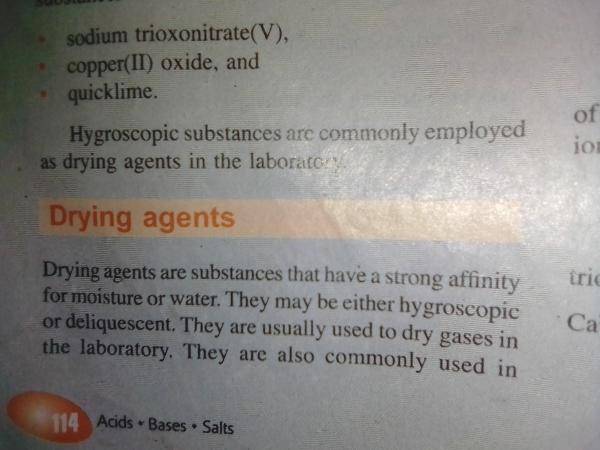
Efflorescence gives out water to the surrounding
While hygroscopic takes in water hence a drying agent
Reference: my school chem. Pg 114 chapt. 6 Acid, Base, Salt

Myschool, the answer shd be C cos drying agents are usually hygroscopic and deliquescent substances

Note: It is also by Deliquescence.
What that means:
1. Hygroscopic: The salt readily absorbs water vapor from the air. It pulls moisture into its crystal structure to form hydrates. Example: anhydrous copper(II) sulfate turns blue as it absorbs water to become CuSO4.5H2O.
2. Deliquescent: A stronger version. The salt absorbs so much water from the air that it dissolves in that water and forms a solution. Example: calcium chloride and sodium hydroxide NaOH pellets will turn into puddles if left open.
How it works as a drying agent
The salt has a strong affinity for water, so it removes moisture from gases or from the air inside a closed container. The driving force is the salt’s tendency to lower its vapor pressure by forming a more stable hydrated form.
Common lab drying agents: anhydrous CaCl2, MgSO4, Na2SO4, silica gel.
So short answer: their ability to absorb water due to being hygroscopic/deliquescent.
Whatsapp Number: 0812 535 5537.

