WAEC and NECO CBT App for Mobile Devices - Candidates, Schools, Centres, Resellers - 100% Offline -Download Now
WAEC and NECO CBT Software for Computers and Laptops - Candidates, Schools, Centres, Resellers - 100% Offline -Download Now

2012 WAEC Chemistry Theory  (a) (i) Define standard electrode potential. (ii) State two factors that affect the value of...

Chemistry
WAEC 2012

 (a) (i) Define standard electrode potential.

(ii) State two factors that affect the value of standard electrode potential.

(iii) Give two uses of the values of standard electrode potential.

(iv) Draw and label a diagram for an electrochemic cell made up of Cu\(^{2+}\)/Cu; E° = +0.34 V  Zn\(^{2+}\)/Zn; E° = -0.76 V

(v) Calculate the e.m.f. of the cell in (a)(iv) above.

(b) (i) In terms of electron transfer, define: I. oxidation; II. oxidizing agent.

(ii) Balance the following redox reaction: MnO\(^{-4}\) + l\(^{-}\) \(\to\) l\(_{2}\) + Mn\(^{2+}\)

(c) Classiify each of the following oxides as basic, amphoteric, acidic or neutral: (i) Carbon (II) oxide; (ii) Sulphu (IV) oxide; (iii) Aluminium oxide; (iv) Lithium oxide.

(d) What is hydrogen bonding?

Post-UTME Past Questions - Original materials are available here - Download PDF for your school of choice + 1 year SMS alerts
WAEC and NECO CBT Software for Computers and Laptops - Candidates, Schools, Centres, Resellers - 100% Offline -Download Now
Post UTME Past Questions Agent
Explanation

a)(i) It is a measure of the tendency of an element to form ions in solution relative to the tendency of hydrogen atoms to form ions in solution at standard conditions (at 298K and 1 atom and 1 molar concentration)

(ii) Concentration, Temperature, Pressure.

— To predict the direction/feasibility of a chemical reaction

— To calculate the e.m.f of a cell

— To predict the standard potential of unknown elements.
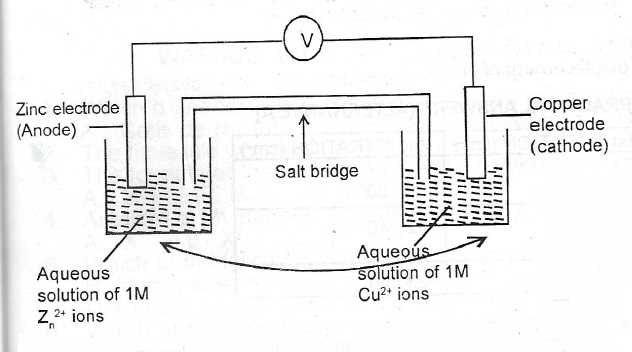
(v) = Emf = E°(Right) — E°(Left)

= + 0.34 — (— 0.76) V

= +1.10V


(b)(i) I Oxidation — a process of electron loss

II. Oxidizing agent—an electron acceptor

(ii) Separate into half reactions


(c) (i) Neutral (ii) Acidic (iii) Amphoteric (iv) Basic


(d) Hydrogen bonding is an intermolecular force between molecules in which hydrogen is attached to a very electronegative atom which has a small size, e.g. N, O, F.


Report an Error Ask A Question Download App
WAEC and NECO CBT Software for Computers and Laptops - Candidates, Schools, Centres, Resellers - 100% Offline -Download Now
WAEC and NECO CBT App for Mobile Devices - Candidates, Schools, Centres, Resellers - 100% Offline -Download Now
Post-UTME Past Questions - Original materials are available here - Download PDF for your school of choice + 1 year SMS alerts

Contributions ({{ comment_count }})

Please wait...

{{ settings.no_comment_msg ? settings.no_comment_msg : 'There are no comments' }}

Quick Questions

Post your Contribution

Please don't post or ask to join a "Group" or "Whatsapp Group" as a comment. It will be deleted. To join or start a group, please click here

{{ quote.posted_by.display_name }}
{{ settings.form_textarea_description }}
 
Post UTME Past Questions Agent
Your School's Whatsapp Group - Join Us now
Post-UTME Past Questions - Original materials are available here - Download PDF for your school of choice + 1 year SMS alerts
WAEC and NECO CBT App for Mobile Devices - Candidates, Schools, Centres, Resellers - 100% Offline -Download Now
WAEC and NECO CBT Software for Computers and Laptops - Candidates, Schools, Centres, Resellers - 100% Offline -Download Now
Post-UTME Past Questions - Original materials are available here - Download PDF for your school of choice + 1 year SMS alerts
WAEC and NECO CBT App for Mobile Devices - Candidates, Schools, Centres, Resellers - 100% Offline -Download Now
Post UTME Past Questions Agent
Your School's Whatsapp Group - Join Us now
