all the nitrates decompose to their oxides
the nitrate of magnesium gives the nitrite and oxygen
the nitrates of magnesium and iron give the oxides
the nitrate of iron gives the nitrite and oxygen
the nitrate of the magnesium is not decomposed
Explanation
Video Explanation
No video available
Post your Contribution
Discussions (44)

You People Should Not Be Confused, Chemvik Is Right To Some Extent And Also Not Right,
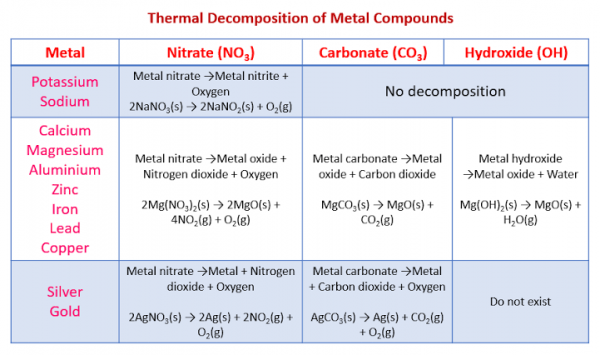
Firstly, You Should Know That Potassium Nitrate And Sodium Nitrate Only Decomposes To Their Respective Nitrite And Not Oxides
Equation Of Reaction
2KNO3= 2KNO2 + O2
2NaNO3= 2NaNO2 + O2
Secondly, From Calcium To Copper Their Trioxonitrate Decomposes To Form Their Oxides Meaning That Magnesium & Iron Decomposes To Their Respective Oxides, While The Remaining Metals In The Reactivity Series Decomposes Into Their Free Metals
Note: Nitrate Is Used For Trioxonitrate(v), While Nitrite Is Used For Dioxonitrate(iii)
The activity series-
K Na Ca Mg Al Zn Fe Sn Pb H Cu Hg Ag Au
1) K & Na nitrates decompose on heating to form their nitrites and oxygen. Eg
2KNO3 = 2KNO2 + O2
2NaNO3= 2NaNO2 + O2
2) Nitrates of Ca to Cu decompose to form their oxides, NO2 and O2. Eg
Mg(NO3)2 = MgO + 2NO2 + O2
3) Then nitrates of Hg downwards will decompose to give their metals NO2 and O2.
Eg
2AgNO3 = 2Ag + 2NO2 + O2

All salts of nitrate are decomposed on heating bt d degree of their decomposition are not the same.the nitrate salt of group 1 decompose to dia dioxonitrate and oxygen.while moderately reactive metals frm Ca to Cu decompose to dia metallic oxide,nitrogen(iv)oxide and oxygen.d less reactive metals e.g Ag decompose to its elemental form,nitrogen(iv)oxide and oxgen.Hg needs no heating bcos its a liquid metal and Au is almost inert.
in the electrochemical series..d earliest part of it i.e potassium,magnesium etc decomposes to form the dioxonitrate and oxygen, the middle part decomposes to form an oxide,oxygen nd nitrogen(iv) oxide, while the last part decomposes to form the metal, oxygen, nd nitrogen(iv)oxide!

The is c. The nitrates and carbonates of sodium and potassium are not decomposed. This is probably due to the strong electrostatic forces that occur in this compound. However, the hydrogen carbonates of sodium and potassium decomposes.

with my own understanding i will say that decomposition k, Na gives dioxonitrate 3 and O2 while Mg ,Fe gives No2 and O2
Option A states that all the nitrates decompose to their oxides, which is not accurate.
option C is correct as it correctly identifies the decomposition products of the nitrates of magnesium and iron, while also stating that potassium nitrate decomposes into its oxide.


The correct answer is:
**C. The nitrates of magnesium and iron give the oxides.**
### Explanation:
The thermal decomposition of nitrates depends on the metal in the reactivity series:
1. **Potassium Nitrate (KNO₃)**:
- Decomposes to give **potassium nitrite (KNO₂) and oxygen (O₂)**.
- Reaction:
\[
2KNO_3 \rightarrow 2KNO_2 + O_2
\]
- Group 1 metal nitrates (except lithium) decompose to nitrites and oxygen.
2. **Magnesium Nitrate (Mg(NO₃)₂)**:
- Decomposes to give **magnesium oxide (MgO), nitrogen dioxide (NO₂), and oxygen (O₂)**.
- Reaction:
\[
2Mg(NO_3)_2 \rightarrow 2MgO + 4NO_2 + O_2
\]
- Magnesium is in Group 2, and Group 2 metal nitrates decompose to their oxides.
3. **Iron(III) Nitrate (Fe(NO₃)₃)**:
- Decomposes to give **iron(III) oxide (Fe₂O₃), nitrogen dioxide (NO₂), and oxygen (O₂)**.
- Reaction:
\[
4Fe(NO_3)_3 \rightarrow 2Fe_2O_3 + 12NO_2 + 3O_2
\]
- Transition metal nitrates decompose to their oxides.
### Why Other Options Are Incorrect:
- **A**: Incorrect, because potassium nitrate does not form an oxide but a nitrite.
- **B**: Incorrect, magnesium nitrate decomposes to **MgO**, not nitrite.
- **D**: Incorrect, iron(III) nitrate decomposes to Fe₂O₃, not nitrite.
- **E**: Incorrect, magnesium nitrate **does** decompose.
Thus, the correct choice is **C**.