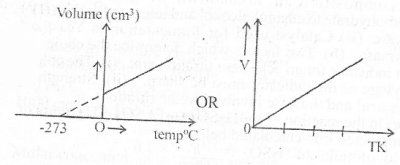
(a)(i) Sketch a graphical representation of Charles' law.
(ii) Calculate the volume of oxygen that would be required for the complete combustion of 2.5 moles of ethanol at s.t.p. [molar volume at s.t.p. = 22.4 dm\(^3\)]
(b)(i) State the collision theory of reaction rates.
(ii) Using the collision theory, explain briefly how temperature can affect the rate of a chemical reaction.
(c)(i) Define esterification.
(ii) Give two uses of alkanoates.
(iii) Give the products of the alkaline hydrolysis of ethyl ethanoate.
(d) A tin coated plate and a galvanized plate were exposed for the same length of time.
(i) Which of the two plates corrodes faster
(ii) Explain briefly your answer in 2(d)(i)
Explanation
Video Explanation
No video available
Post your Contribution
Discussions (8)

Sorry ,these questions are not what is in the printed past question and the snswers are not even complete the diagram for charles law was not given.please Myschool should deal with these problems.


i) The galvanized plate will corrode faster.
(ii) Zinc is more reactive than tin and will corrode before the tin layer on the tin-coated plate. This leaves the tin layer exposed, which then corrodes faster than the zinc layer on the galvanized plate.

