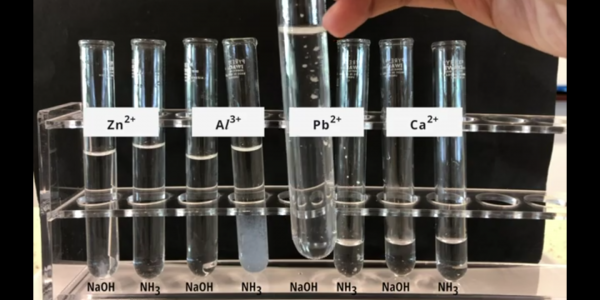
An aqueous solution of a metal salt, M. gives a white precipitate with NaOH which dissolves in excess NaOH. With aqueous ammonia, the solution of M also gives a white precipitate which dissolves in excess ammonia Therefore the cation in M is
Zn
Ca
Al
Pb
Explanation
No explanation available
Video Explanation
Post your Contribution
Discussions (5)

Option A is correct
pb²+,Zn²+ and Al³+ have similar reactions only that Al³+ is insoluble in NH4cl or in dilute HCl it doesn't give a white ppt
You are correct aluminium will not dissolve in excess,while Pb dissolve Hcl in excess

The behavior of the metal salt, M, provides valuable clues about its cation. Let's analyze the observations:
1. **White Precipitate with NaOH**: When NaOH is added to the solution of M, a white precipitate forms. This indicates the presence of a metal hydroxide. The fact that the precipitate dissolves in excess NaOH suggests that the metal hydroxide is not insoluble.
2. **White Precipitate with Aqueous Ammonia**: Similarly, when aqueous ammonia (NH₃) is added to the solution of M, another white precipitate forms. Again, the fact that this precipitate dissolves in excess ammonia indicates that the metal complex formed is not insoluble.
Based on these observations, we can deduce that the cation in M is **aluminum (Al)**. Aluminum hydroxide (Al(OH)₃) and aluminum ammine complex ([Al(NH₃)₆]³⁺) are both white precipitates that dissolve in excess NaOH and ammonia, respectively.
Therefore, the correct answer is **C. Al**.

