Methanoic acid mixes with water in all proportions and has about the same boiling point as water. Which of the following methods would you adopt to obtain pure water from a mixture of Sand, water and methanoic acid?
Extractive distillation
Filtration followed by distillation
Neutralization with sodium hydroxide followed by distillation
Neutralization with sodium hydroxide followed by filtration
Explanation
Video Explanation
Post your Contribution
Discussions (33)

for me the correct order should have been
Neutralization + Filtration+ distillation
because our main concern is to obtain pure water
when you (1) neutralize with sodium hydroxide you convert it methanioc acid to form sodium methanoate ( this is soluble in water) but sand is not which you can remove sand by (2)filtration and Left with the solution (sodium methanoate)
which can be separated by (3)distillation to get pure water because the boiling point of sodium methanoate is higher than that of water.
but from the options given B is what I will go for
the ans is b fractional distillation seperates close boiling point compounds but cannot remove the sand
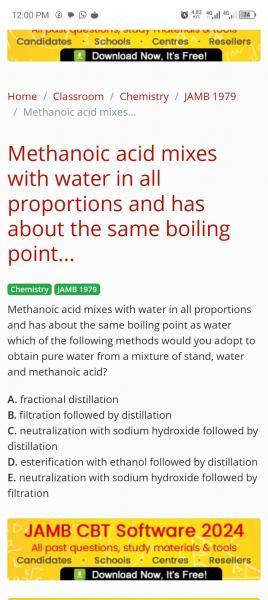
here my school choose E as the answer
the answer is D. sodium hydroxide react with methanoic acid because methanoic acid and water have similar boiling points. sodium hydroxide react with methanoic acid and gives a salt so filtration can be done easily to get water.
D
Myschool, the answer is C.....please review this and make correction as soon as possible. Thanks
i will go for B filtration fillowed by distillation... the sand is filtered off and wtaer and weak base methanioc acid is distilled.
Extractive distillation is defined as distillation in the presence of a miscible, high-boiling, relatively non-volatile component, the solvent, that forms no azeotrope with the other components in the mixture. The method is used for mixtures having a low value of relative volatility, nearing unity.
From WIKIPEDIA
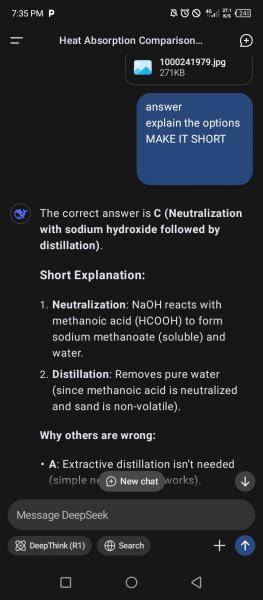
The correct answer is: B) Filtration followed by distillation
---
🔍 Let’s break it down simply:
You have a mixture of:
Sand (insoluble solid)
Water (liquid)
Methanoic acid (HCOOH) (liquid, mixes with water, and has a boiling point close to water)
---
Step 1: Remove the sand
Sand does not dissolve in water
So you can separate it using filtration
👉 After filtration:
Residue: Sand
Filtrate: Water + methanoic acid
---
Step 2: Separate water from methanoic acid
Methanoic acid:
Mixes completely with water
Has a boiling point close to water
👉 This means:
Simple distillation may not give very good separation, but it is still the standard method used in exams for such mixtures.
During distillation:
Water (boils at ~100°C) will vaporize
Methanoic acid mostly remains in the flask (or may partially distill, but separation is based on boiling differences)
---
❌ Why the other options are wrong:
A) Extractive distillation
Not a standard school-level method for this type of question
Requires adding another solvent (not given)
C) Neutralisation + distillation
Neutralisation would react methanoic acid with NaOH:
HCOOH + NaOH → HCOONa + H₂O
But then you no longer have “pure water” — you now have salt (sodium formate) in the mixture
❌ Not suitable
D) Neutralisation + filtration
Still leaves dissolved substances in solution
Filtration cannot remove dissolved salts or liquids
❌ Incorrect
✅ Final Answer: B) Filtration followed by distillation
💡 Simple exam trick:
Sand present? → Filtration
Liquids with different boiling points? → Distillation
Dissolved solids? → Not filtration — need evaporation/distillation
According to the question to obtain pure water from a mixture of sand, water and methanoic acid. THE ANSWER IS OPTION C: Neutralization with sodium hydroxide followed by distillation

