X(g) + 3Y(g) ---- 2z(g) H = +ve. if the reaction above takes place at room temperature, the G will be
negative
zero
positive
indeterminate
Explanation
Video Explanation
Post your Contribution
Discussions (24)

C is correct.....at ROOM temperature free energy (G) is positive for endothermic reaction and negative for exothermic reaction.....reference new school chemistry ababio page 248.....
C is correct
Entropy of the system reduced
Since entropy of the system decreased and the reaction endothermic there would be a large increase in free Energy
therefore G is positive 🤲
🤲

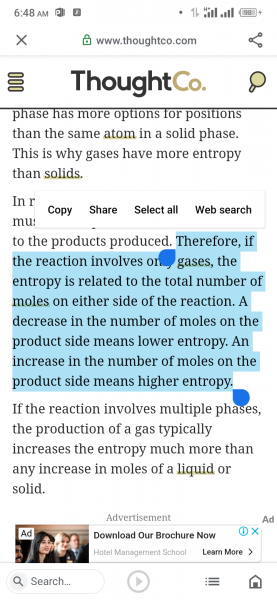
MYSCHOOL,this is a prove that the entropy change can be determined from the balanced chemical eqn. The answer should therefore be C

All the species involved are all gases and the number of moles on the product side is less than that on the reactant side therefore ∆S likely to be negative, T = +ve (room temperature)
∆G = ∆H - T∆S
since ∆S = -ve, ∆T = +ve and ∆G = ∆H - T∆S
therefore ∆G = ∆H - (-ve)
∆H is +ve (given)
so ∆G = +ve (Endergonic/Non spontaneous) {C }
}

The answer is C. positive.
Here's why:
* ΔH = +ve: This means the reaction is endothermic, it absorbs heat from its surroundings.
* ΔS: To figure out the entropy change, let's look at the change in the number of moles of gas. There are 4 moles of gas on the reactants' side and 2 moles of gas on the products' side. The entropy change is negative.
* ΔG = ΔH - TΔS: ΔG is Gibbs free energy, ΔH is enthalpy, T is temperature, and ΔS is entropy.
* At room temperature: T is a positive value.
* Putting it together: Since ΔH is positive and TΔS is negative, -TΔS will be positive. Therefore, ΔG will be positive.
my school review this because this , the answer is D because the temperature wasn't given so it will be impossible to determine whether the reaction will be positive or negative so D is correct
From my knowledge, it should be C.
From a different perspective;
if we are given values for this question, ∆H = +(x) , ∆S = -(y)
for G to be negative, H has to be negative and greater than T•S. Please rectify this. This is wrong.

