10cm3 of hydrogen fluoride gas react with 5cm3 of dinitrogen difluoride gas (N2F2) to form 103 of a single gas. Which of the following is the most likely equation of the reaction?
HF + N2F2 \(\to\) N2HF3
2HF + N2F2 \(\to\) 2NHF2
2HF + N2F2 \(\to\) N2H2F3
HF + 2N2F2 \(\to\) N4HF2
Explanation
No explanation available
Video Explanation
No video available
Post your Contribution
Discussions (13)

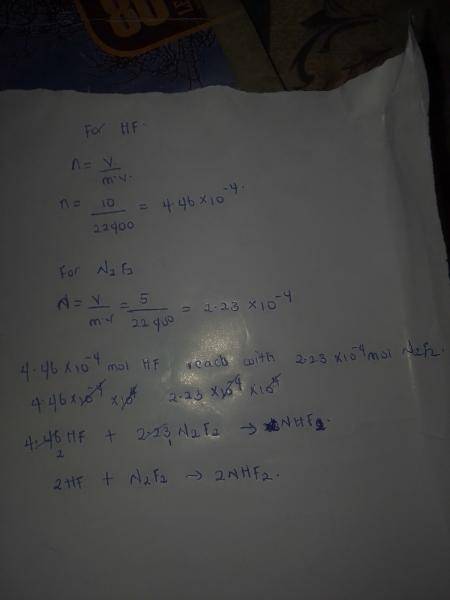



We can use the balanced chemical equation to determine the expected volume of gas produced from a given volume of reactants.
Let's start by writing the balanced chemical equations for the reactions in each of the answer choices:
A. HF + N2F2 → N2HF3
B. 2HF + N2F2 → 2NHF2
C. 2HF + N2F2 → N2H2F3
D. HF + 2N2F2 → N4HF2
To determine the expected volume of gas produced by each equation, we need to compare the volumes of the reactants and products.
Answer choice A involves the formation of N2HF3, which has the same number of atoms as the reactants. Therefore, the volume of gas produced should be the same as the sum of the volumes of the reactants, which is 10 cm3 + 5 cm3 = 15 cm3. This doesn't match the given information that 10 cm3 of hydrogen fluoride gas and 5 cm3 of dinitrogen difluoride gas react to form 10 cm3 of a single gas, so we can eliminate answer choice A.
Answer choice B involves the formation of 2NHF2, which has two hydrogen atoms and two fluorine atoms, compared to the three hydrogen atoms and two fluorine atoms in the reactants. Therefore, this equation implies that some of the hydrogen fluoride reacts with the dinitrogen difluoride to form a different product. The expected volume of gas produced should be less than the sum of the volumes of the reactants, which is 10 cm3 + 5 cm3 = 15 cm3. This doesn't match the given information, so we can eliminate answer choice B.
Answer choice C involves the formation of N2H2F3, which has the same number of atoms as the reactants. Therefore, the volume of gas produced should be the same as the sum of the volumes of the reactants, which is 10 cm3 + 5 cm3 = 15 cm3. This doesn't match the given information, so we can eliminate answer choice C.
Answer choice D involves the formation of N4HF2, which has four hydrogen atoms and two fluorine atoms, compared to the three hydrogen atoms and two fluorine atoms in the reactants. Therefore, this equation implies that some of the hydrogen fluoride reacts with the dinitrogen difluoride to form a different product. The expected volume of gas produced should be less than the sum of the volumes of the reactants, which is 10 cm3 + 5 cm3 = 15 cm3. This matches the given information that 10 cm3 of hydrogen fluoride gas and 5 cm3 of dinitrogen difluoride gas react to form 10 cm3 of a single gas. Therefore, the most likely equation of the reaction is:
HF + 2N2F2 → N4HF2

The answer is C.
Just the basic understanding of Gay Lussac's of Combining Volumeslaw. Look very well, the volume from the question is in ratio 2:1: 2 (10cm3,5cm3,10cm3), this means we should have something like:
2x + y-----> 2z

