nitrogen and oxygen
carbon (IV) oxide and oxygen
noble gases and carbon (IV) oxide
oxygen and noble gases
Explanation
Video Explanation
Post your Contribution
Discussions (15)

Air is a gaseous mixture that consist mainly of oxygen and nitrogen gases and small quantity of carbon iv oxide, noble gases, water vapour and dust particles. Under normal condition of temperature and pressure,air which is a gaseous mixture, consisting of oxygen carbon iv oxide and nitrogen which are slightly soluble in water, would do so at high pressure but decreases at high temperature. i.e the solubility of air which is a gaseous mixture of oxygen, carbon iv oxide and nitrogen gases will become more soluble in water at high pressure and become less soluble in water at high temperature. So, in the process of boiling out the air in the form of steam will bring out nitrogen. Carbon iv oxide and oxygen gases, as the solubility of these gases will decrease since the temperature of water has become increased in the process of boiling..............................permit me to give out this illustration. This question is premised on AIR which is boiled out in the form of steam................................option B is correct. But that guy above me was giving a wrong explanatory note.that was why i have to modified it. Thanks

Below is the order of increasing solubility of the constituents of air in water:
Nitrogen < Neon < Helium < Argon < Oxygen < Krypton < Carbon dioxide.
From this, nitrogen is the least soluble followed by light noble gases like Ne, He, then Ar.
Oxygen is more soluble than these . Krypton, though a noble gas is more soluble than oxygen.
CO2 is the most soluble.
When water boils, it is richer in the less soluble gases like N2, Ne, He and Ar are the first to leave.
Oxygen will follow but not as quickly.
Krypton and CO2 will tend to remain dissolve longer.
From the above explanation, option A (N2 and O2) and D (O2 and noble gases) have high probability of being the answer. However, the answer is A.
So why not A (N2 and O2)?!
Because while N2 is least soluble, O2 is more soluble than some noble gases like Ar, He and Ne; meaning noble gases as a group (excluding Krypton) are less soluble and will appear more in the steam along with N2, not necessarily O2.
But the question asks for the correct combination. Let's review options A and D.
Option A (N2 and O2) seems good because N2 is least soluble and O2 is still relatively low.
Option D ( O2 and noble gases) is also valid if we are not considering Krypton heavily.
However, if we are strictly going by the lowest solubility, the gases most likely to be in steam are:
N2, He, Ne, Ar - and these are not mentioned together in any option.
Final conclusion:
Given the options, the most accurate answer, considering all the common air constituents and their solubility, would be:
A. Nitrogen and oxygen.
Because:
Both are major constituents of air.
Both are less soluble that CO2 and Krypton (a noble gas)
Nitrogen is the least soluble, and oxygen follows shortly after Ar.
Noble gases, while less soluble than O2, are present in very small amounts, making D less valid in this context.
Answer: A. Nitrogen and oxygen is best when Kr is considered from given options.

When water is boiled, the dissolved air inside it escapes. But the gases do not escape equally. The ones that dissolve more easily in water come out in higher proportion when the water is heated.
Gases that are more soluble in water than nitrogen are
Oxygen
Noble gases (especially Argon as I've heard)
Nitrogen is less soluble, so it is not as rich in the air that comes out.
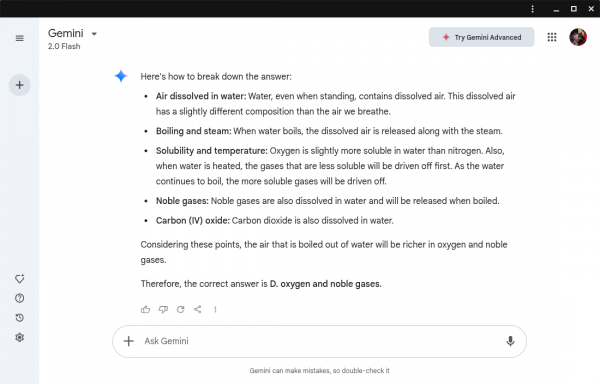
So the air boiled out of water becomes richer in oxygen and noble gases compared to normal air.
When water is boiled, the dissolved air inside it escapes. But the gases do not escape equally. The ones that dissolve more easily in water come out in higher proportion when the water is heated.
Gases that are more soluble in water than nitrogen are
Oxygen
Noble gases (especially Argon as I've heard)
Nitrogen is less soluble, so it is not as rich in the air that comes out.
So the air boiled out of water
becomes richer in oxygen and noble gases compared to normal air.
So the answer is D