4
3
2
1
Explanation
Video Explanation
Post your Contribution
Discussions (21)

There are 4 isomers :
1) CH3CH2CH2CH2Cl
2) CH3CH2CH(Cl)CH3
3) CH3CH(CH3)CH2Cl
4) CH3C(CH3,Cl)CH3


The isomers are 4
1-chlorobutane
2-chlorobutane
2-chloro-2-methylpropane
1-chloro-2-methylpropane.

Kudos to my school team
I need more explanations
If possible a video drawing all the structures possible for clarity and depper understanding


There are four structural isomers with the
molecular formula C 4H9 Cl. These structural
isomers are 1-chlorobutane, 2-chlorobutane, 1-
chloro-2- methylpropane and 2-chloro-2-
methylpropane . Molecules are structural
isomers only if they have: the same molecular
formula. #outlined this words


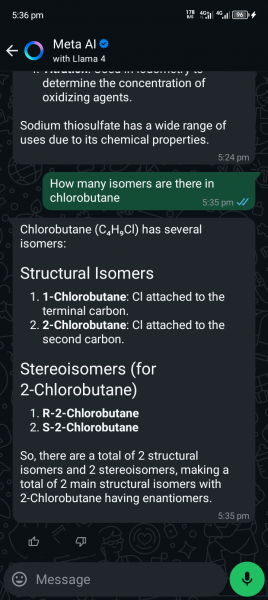
Chlorobutane is a compound with the molecular formula C4H9Cl. There are two possible structural isomers of chlorobutane:
1-Chlorobutane (also known as n-butyl chloride or simply chlorobutane): In this isomer, the chlorine atom is attached to the first carbon atom in the butane chain. The structure is CH3-CH2-CH2-CH2-Cl.
2-Chlorobutane (also known as sec-butyl chloride): In this isomer, the chlorine atom is attached to the second carbon atom in the butane chain. The structure is CH3-CH2-CH(Cl)-CH3.
please correct this
The answer is 2 namely 1-chlorobutane and 2-chlorobutane, there is no 3 & 4 chlorobutane bcos when you are doing the nomenclature and you count the carbon atoms, you still get (1 or 2 chlorobutane) no matter where you put the chlorine atom. If the question had written the molecular formular (C4H9Cl), there would have been 6 isomer i.e (1-methyl2-chloro propane, 2-methyl 2- chloropropane etc) but the question specifically said "chlorobutane". To confirm better check A'levels text coursebook, under the topic hydrcarbon. So myschool you were right before, the answer is "C".

