Which of the compounds above would react to take up two molecules of bromine durng bromination?
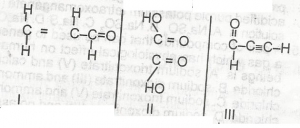
l only
lll only
l and ll only
ll and lll only
Explanation
No explanation available
Video Explanation
No video available
Post your Contribution
Discussions (13)

hmm...i don't think C is the answer, my reason is just because only alkynes can take up 2moles of bromine
Pls can anyone here correct me in anyway?
all the best
smarty

The answer is B, I'll explain
One mole of diatomic molecule e.g bromine is needed to break the double bond into a single bond in alkenes
Two moles of diatomic molecule is needed to break the triple bond into a single bond in alkynes
So the answer should be B. Theres a triple bond there.
Ref--> Chemical properties of alkenes and alkynes
Two bromine molecule are needed

The selected answer is wrong:
I think the answer should be b because it is only ethyne that can take up to 2 moles of bromine

my school correct the answer, the actual answer is B III
it is only alkynes that can take up to 2 molecules of bromine due to it's triple bond 😪
Please myschool, review that answer cos it is absolutely wrong. I is an unsaturated alkanoic acid which can take up only two atoms of bromine to become saturated.. and two atoms of bromine is just one molecle of bronine. II is a dicarboxylic acid which doesnt will also only collect two atoms (one mole) of bromine to replace the two OH.
It is only II that can accept 4 atoms (2 moleclues) of bromine perfectly. Thank u
It's only alkynes that have that characteristic property of reacting with two molecules of bromine to form the corresponding alkane.
The compound that would react to take up two molecules of bromine during bromination is l only. This is because l has a double bond between carbon and carbon, which allows it to undergo addition reactions, such as bromination. The double bond is broken, and a bromine atom is added to each carbon atom, resulting in the product with two bromine atoms attached to it. On the other hand, lll has no double bonds and cannot undergo addition reactions like bromination. Therefore, l and ll only have double bonds and can react to take up two molecules of bromine during bromination.
The correct answer is C

