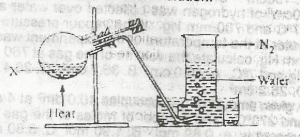
sodium trioxonitrate (V) and ammonium chloride
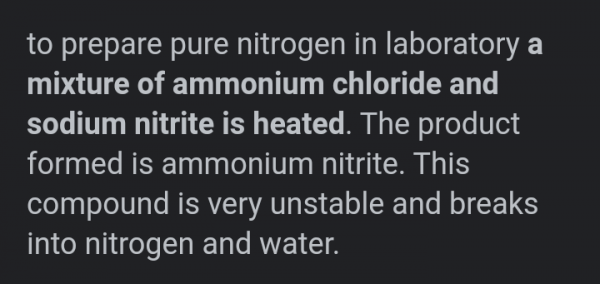
sodium trioxonitrate (lll) and ammonium chloride
lead (ll) trioxonitrate (V) and copper turnings
potassium trioxonitrate (V) and copper turnings
Explanation
Video Explanation
No video available
Post your Contribution
Discussions (26)

For the choosen answer to be correct, it ought to have been sodium dioxonitrate (iii) and ammonium chloride. Please make correction my school

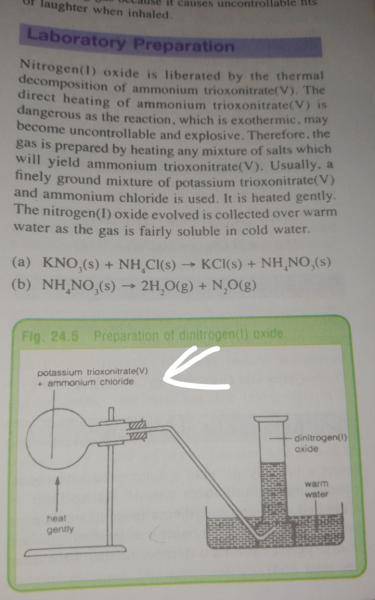
the diagram above is the preparation of dinitrogen(I) oxide..........the solution is a mixture of potassium trioxonitrate(V) and ammonium chloride.
New school chemistry page 413

Step 1: Analyze the clues
Forms a white precipitate → Could be Al³⁺, Zn²⁺, Pb²⁺, Ca²⁺, etc.
Soluble in excess NaOH → Indicates amphoteric behavior
Amphoteric cations: Al³⁺, Zn²⁺, Pb²⁺
Non-amphoteric: Ca²⁺, Na⁺ → insoluble in excess NaOH
Insoluble in excess NH₃ → Rules out Zn²⁺ (Zn(OH)₂ dissolves in NH₃ forming [Zn(NH₃)₄]²⁺)
Dissolves in dilute HCl → Confirms it is a hydroxide like Al(OH)₃ or Pb(OH)₂
Step 2: Narrow down possibilities
Cation Amphoteric? Soluble in NaOH? Soluble in NH₃?
Al³⁺  Yes Yes
  No
No
Zn²⁺ Yes Yes Yes
Pb²⁺ Yes Yes No
Ca²⁺ No No No
Na⁺ No No No
Since the precipitate is insoluble in NH₃, Zn²⁺ is ruled out.
Among the remaining amphoteric cations, Al³⁺ is the classic example in textbooks.
 Answer:
D. Al³⁺
please make corrections to the question its confusing
it should be dioxo not trioxo