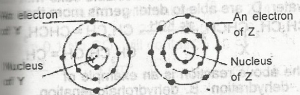
The electrons of two atoms Y and Z are arranged in shells as shown above. The bond formed between the atoms of Y and Z is
ionic
covalent
dative
metallic
Explanation
Video Explanation
No video available
Post your Contribution
Discussions (8)


The bond between silicon (Si) and chlorine (Cl) is a polar covalent bond.
Here's why:
Silicon and chlorine are both nonmetals, so they form covalent bonds by sharing electrons.
However, chlorine is more electronegative than silicon, meaning it pulls the shared electrons closer to itself.
This difference in electronegativity makes the bond polar—the chlorine end is slightly negative, and the silicon end is slightly positive.
So, it's a polar covalent bond, not purely ionic or nonpolar.

The selected answer is wrong:
The first one has three electron in it outermost shell so it is a metal and the second one is non metal and the bond between metal and non metal is ionic

