


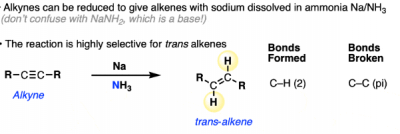
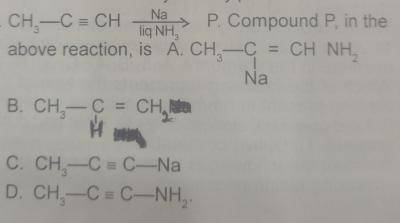
When propyne (methylacetylene) reacts in the presence of sodium (Na) and liquid ammonia (NH₃), it undergoes a reduction reaction.
Propyne (CH₃C≡CH) is reduced to form propene (CH₃CH=CH₂) through the trans addition of hydrogen.
During the reaction, the sodium (Na) dissolves in the liquid ammonia (NH₃) to form a blue-colored solution of solvated electrons, which act as a reducing agent. The sodium is oxidized, releasing electrons that are then used to reduce the propyne. The ammonia acts as a solvent and helps to stabilize the solvated electrons.
So, the sodium is essentially consumed during the reaction, and the ammonia acts as a catalyst or solvent, helping to facilitate the reduction reaction.
The sodium (Na) and ammonia (NH₃) don't interfere with the product formed, which is propene (CH₃CH=CH₂), rather they play a role in facilitating the reaction, but they don't become part of the final product. The sodium is consumed during the reaction, and the ammonia can be recovered or removed, leaving behind the desired product, propene.





Contributions ({{ comment_count }})
Please wait...
Modal title
Report
Block User
{{ feedback_modal_data.title }}