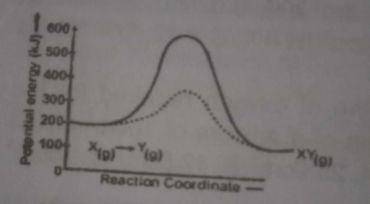
The above diagram gives the potential energy profile of the catalyst and uncatalysed reactions of X(g) + Y(g) → XY(g). Deduce the respective activation energies in KJ of the catalysed and uncatalysed reverse reactions: XY(g) → X(g) + Y(g)
300, 500
500, 300
-300, -500
-500, -300
Explanation
Video Explanation
No video available
Post your Contribution
Discussions (22)

A is correct
Explanation
Though the values are not clear but with common sense you know that the catalysed reaction will be having lesser value of activation energy and the uncatalysed reaction will be higher in activation energy. The only values given are 300 and 500 hence the 300 for catalysed, 500 for uncatalysed. Now, that's not all; the diagram is the energy profile diagram for an exothermic reaction which has negative sign (-300, -500). Since it has been reversed according to question, then A would be correct
.
300 and 500


A should be the correct answer since the profile diagram for the forward reaction is that of an exothermic one I.e delta is negative.
Then for the reverse reaction, delta should be positive I.e endothermic,so the answer should be Positive not negative
The product level is lower than the reactant's level so I think it should be exothermic reaction


The question asks for the activation energy of the reverse reaction (energy released) , option A is the activation energy of the forward reaction (energy added).
mathematically,
uncatalyzed reaction : 100- 600 = - 500
catalyzed reaction : 100 - 400 = - 300
C

