2-butanone
2-butanal
butane
butanoic acid
3-butanal
Explanation
Video Explanation
No video available
Post your Contribution
Discussions (16)

Let's solve this chemistry problem correctly, step by step.
1. Identify the Molecule
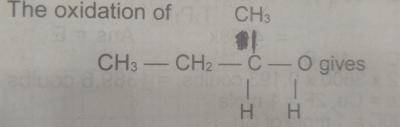
* Look closely at the molecule: CH3-CH2-CH(CH3)-OH.
* The key is the -OH group. This tells us it's an alcohol.
* Now, look at the carbon that the -OH is attached to. How many other carbons is it connected to? It's connected to two other carbons (the CH2 and the CH3).
* This means it's a secondary alcohol.
2. Oxidation of Secondary Alcohols
* Remember, when we oxidize (add oxygen to) a secondary alcohol, it turns into a ketone.
* Ketones have a C=O (carbonyl) group in the middle of the carbon chain.
3. Analyze the Answer Choices
* A. 2-butanone: This is a ketone. The "2-" tells us the C=O group is on the second carbon. This fits our rule!
* B. 2-butanal: This is an aldehyde (C=O at the end of the chain), not a ketone.
* C. butane: This is an alkane (just carbon and hydrogen), not an oxidized alcohol.
* D. butanoic acid: This is a carboxylic acid (-COOH group), formed from further oxidation of some alcohols, but not directly from secondary alcohols.
* E. 3-butanal: This is also an aldehyde.
4. The Correct Answer
* The correct answer is A. 2-butanone.
Why 2-butanone?
* Our molecule is a secondary alcohol with four carbons.
* When it's oxidized, it forms a ketone with four carbons.
* "2-butanone" means the C=O group is on the second carbon, which is exactly what happens when this molecule is oxidized.
I hope that helps!


