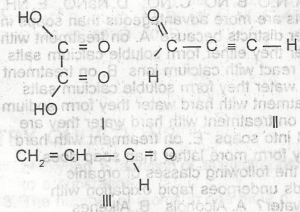
l
ll
lll
l and ll
l and lll
Explanation
No explanation available
Video Explanation
No video available
Post your Contribution
Discussions (17)

The reaction of bromine with compounds typically involves the addition of bromine across double or triple bonds, such as those found in alkenes and alkynes. This is because bromine is an electrophile that can be added to the electron-rich double or triple bonds.
Carbonyl compounds, such as aldehydes and ketones, can also react with bromine, but the reaction usually involves the alpha carbon (the carbon adjacent to the carbonyl group). However, carboxylic acids, esters, and amides generally do not undergo this reaction.
Based on the image description and the information:
Compound I: It has a double bond between two carbon atoms and contains a carbonyl group (C=O).
Compound II: It is an alkyne with a triple bond between two carbon atoms.
Compound III: It is an alkene with a double bond between two carbon atoms and also contains a carbonyl group (C=O).
Compounds I, II, and III all have double or triple bonds, so they should all react with bromine. Therefore, the correct answer is None of the above. If there was an option stating “I, II, and III”, that would be the most accurate answer. But based on the given options, None of the above is the closest.

The question is meant to be "which of the following compounds will take two molecules of bromine?" and not A molecule of bromine.
Thanks.

Compound II contains the triple bond while III contains the double bond.
The questions says Which will take MOLECULES of bromine
Due to unsaturation, Compound III should take only one molecule of Bromine to convert the double bonds to a single bond.
Compound III will take more than one molecule of Bromine
Recall... The question asked for molecules not molecule.
Hence, II should be valid
Success in your exams
Here's a breakdown of the key points:
 Correct Concepts Mentioned:
Bromine reacts via electrophilic addition to double and triple bonds (alkenes and alkynes).
Carbonyl-containing compounds (like aldehydes, ketones, carboxylic acids) do not react with bromine in the same way — except under very specific conditions, such as halogenation at the alpha carbon, which requires acidic or basic catalysis, not just simple bromine addition.
So, in typical bromine water decolorization tests, only unsaturated compounds (alkenes/alkynes) are expected to react and decolorize bromine.
Let’s Re-analyze the Structures Visually:
 Compound I:
On closer inspection of the image:
Contains only carbonyl groups (C=O) and hydroxyls (OH).
No C=C or C≡C bond is present.
Does not react with bromine in a simple addition reaction.
Compound II:
Has a C≡C triple bond (alkyne).
Alkynes do react with bromine via addition.
Will react with bromine.
Compound III:
Has a C=C double bond (alkene).
Alkenes react readily with bromine.
Will react with bromine.
 Flaw in the Explanation You Shared:
The explanation says Compound I has a double bond — it does not. It’s a misinterpretation of the structure. That invalidates the conclusion that all three compounds would react with bromine.
Final Answer:
Only Compounds II and III will take up bromine via electrophilic addition.
Thus, the correct choice is:
E. I and III
B. II
D. I and II
C. III
Correct answer is: "II and III" — which is not listed exactly, but logically it should be.
So the closest correct answer based on available options is not listed properly, but the best match if fixed would be:
"II and III"
The options are wrong, there should be one which says, I, ii, III. Bcoz that's the correct answer. All the compounds possess double or triple bonds and should be capable of taking one bromine molecule

