1
2
3
4
5
Explanation
No explanation available
Video Explanation
No video available
Post your Contribution
Discussions (13)

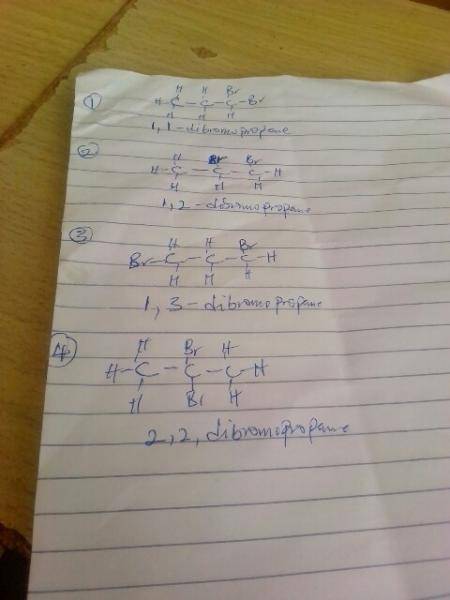
the correct answer is D
list of the isomers are
1.1,1-dibromopropane
2.1,2-dibromopropane
3.1,3-dibromopropane
4.2,2-dibromopropane

An isomer is a compound with the same molecular formula as another compound, but with a different structure and configuration of atoms. In this case, the molecular formula given is C3H6Br2. To determine the number of isomeric forms, we need to consider the different ways the atoms can be arranged.
First, let's focus on the carbon atoms. The carbon atoms can form a straight chain or a branched chain. In this case, there are two possibilities:
A straight chain with three carbon atoms (propyl).
A branched chain with three carbon atoms (isopropyl).
For each of these carbon chains, we need to consider the possible positions of the two bromine (Br) atoms. Let's consider each carbon chain:
Propyl chain: There are three carbon atoms in the chain, numbered as 1, 2, and 3. The two bromine atoms can be attached to the carbon atoms in the following ways:
1,2-dibromo: Both bromine atoms are attached to the first two carbon atoms.
1,3-dibromo: Bromine atoms are attached to the first and third carbon atoms.
2,3-dibromo: Bromine atoms are attached to the second and third carbon atoms.
Isopropyl chain: In this case, there is only one possible arrangement of bromine atoms, which is when both bromine atoms are attached to the two terminal carbon atoms (1,1-dibromo).
Adding up the possible arrangements of the bromine atoms, we have a total of four isomeric forms for the molecular formula C3H6Br2:
1,2-dibromopropane
1,3-dibromopropane
2,3-dibromopropane
1,1-dibromo-2-methylpropane (1,1-dibromoisopropane)
Thus, the correct answer is Option D: 4 isomeric forms.


Not at all myschool. The hydrocarbon derivative above is a dihalo alkane i.e it will exist as 1, 2- dibromopropane and then the other isomer is 2,2- dibromopropane.
The Correct option is B and not D users


