CH3COOC2H5(1) + H2O(1) ⇌ CH 3COOH (aq) + C 2H 5OH (aq)
The purpose of H+ in the reaction above is to
increase the yield of products
maintain the solution at a constant PH
increase the rate of the hydrolysis
decrease the rate of the reverse reaction
Explanation
Video Explanation
No video available
Post your Contribution
Discussions (13)

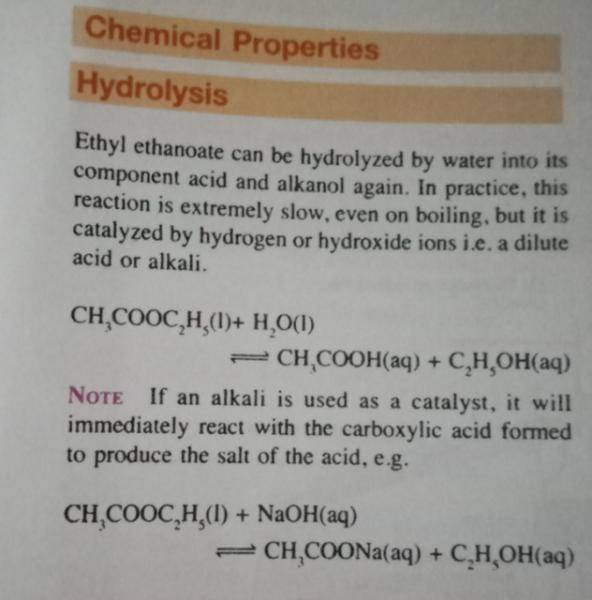
Normally, when you hear “Catalyst”, the first to come into your mind is ‘to speed up’.
I am sure my school would have done a tireless work to provide all these answers for us which we are enjoying today but this particular answer seems not clear to me and to clear this air, I hereby bring to you the prove👇

It should be C cos this time around it's hydrolysis not esterification.
All hydrolysis rxns basically Involve the addition of 1 molecule of water.

The answer is c. Catalysts do not affect the position of equilibrium and hence can not increase the rate of either the forward or the backward reaction alone, instead it increase the rate of the entire reaction, both the backward and forward.

c x correct. u can increase d rate nt yield.catalyst cn nt start a reaction.....
They are correct.... Check ur Ababio txt bk, U'll c under hydrolysis as a chem properties of esters....... A-correct anS
The function of H2O(water) is to increase the yield of the products i.e the Ethanoic acid and ethanol which are the reactants in the esterification the reaction. In the reaction, If More water is added, more products are formed and if water is removed or reduced, the yield of ester is increased and backward reaction is favoured....law of thermodynamics.... Le chatelier's principle applied..!
Admin are absolutely right
I think C is the correct answer because the process involves hydrolysis to get the products which are the reactants in an esterification reaction.

