Ca (HCO3)2 and Mg (HCO3)2 salts
Ca (HCO3)2 and CaCO3 SALTS
Mg(HCO3)2 and CaSO4 salts
CaSO4 and Ca(HCO3)2 salts
Explanation
Video Explanation
Post your Contribution
Discussions (25)
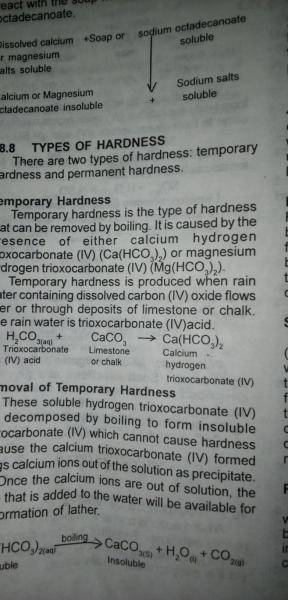

option A is very correct. the Hydrogen carbonate of calcium and magnesium causes temporary hardness of water, and they decomposes on heating to remove the hardness. that is why the hydrogen carbonates of Ca and Mg causes temporary hardness since they decomposes
myschool pls rectify this
The answer is A,because mg and Ca hydrogentrioxocarbonates are responsible only when it is boiled does it form an insoluble trioxocarbonate salt

Water is considered temporarily hard primarily due to the presence of dissolved bicarbonate minerals. These minerals yield calcium and magnesium cations (Ca^2+ and Mg^2+) and bicarbonate anions (HCO3^-). When water contains **calcium bicarbonate (Ca(HCO3)2)** and **magnesium bicarbonate (Mg(HCO3)2)**, it is said to be temporarily hard. Therefore, the correct answer is:
A. Ca (HCO3)2 and Mg (HCO3)2 salts
the problem with myschool dis days is that even when you correct them about a particular question,they will still stand still and defend their wrong answer with rubbish video and explanation.
In the app the answer is showing B while on the website is showing A. And the correct answer is A as is on the website please check and rectify it. Thank you.

Temporary hardness is caused by the present of dissolve calcium hydrogentrioxocarbonate(iv) which discomposes on heating to form calcium trioxocarbonate(iv)
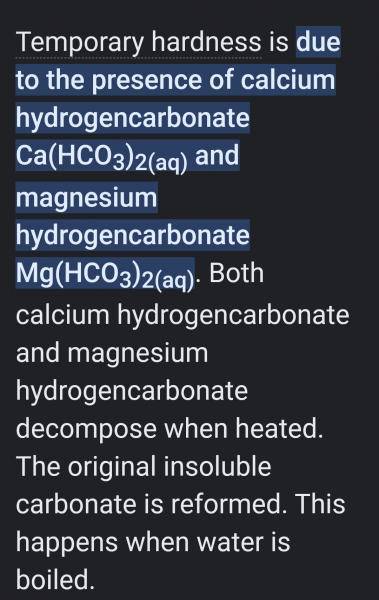
Temporary hardness is due to the presence of calcium hydrogencarbonate Ca(HCO3)2(aq) and magnesium hydrogencarbonate Mg(HCO3)2(aq). Both calcium hydrogencarbonate and magnesium hydrogencarbonate decompose when heated. The original insoluble carbonate is reformed. This happens when water is boiled.
Therefore the answer is A. myschool pls make correction it is confusing people