a compound wich has no water of crystallization
an oxide whose solution in water has a PH greater than 7
an oxide whose solution in water has a PH less than 7
an oxide that has hydrogen atoms
an amphoteric oxide
Explanation
Video Explanation
No video available
Post your Contribution
Discussions (23)

An anhydride is a compound which has no water of crystallization. It can either be acidic or basic.
NOTE:Anhydrous means without water.
It's answer suppose to be -A
but acid anhydride dissolve in water to produce an acid , a ph less than seven it is in the option
Explanation:
The question is asking about an anhydride. An anhydride is a type of compound that is formed when a molecule loses water. It is important to note that anhydrides are not the same as hydrates, which are compounds that contain water molecules in their crystal structure.
The question provides us with five options, and we are to choose the correct one. Option A states that an anhydride is a compound without water of crystallization. While this is partially true, it does not fully explain what an anhydride is.
Option B states that an anhydride is an oxide whose solution in water has a pH greater than 7. This definition is incorrect, as anhydrides are not necessarily oxides, and their solutions in water can have a pH greater than, less than, or equal to 7.
Option C is the correct answer. It states that an anhydride is an oxide whose solution in water has a pH less than 7. This is a more accurate definition of an anhydride as it highlights the acidic nature of these compounds.
Option D states that an anhydride is an oxide that has hydrogen atoms. This definition is incorrect as anhydrides can contain oxygen and other elements, but not necessarily hydrogen.
Option E states that an anhydride is an amphoteric oxide. While some anhydrides can be amphoteric, not all anhydrides exhibit this property.
In summary, the correct option is Option C, which defines an anhydride as an oxide whose solution in water has a pH less than 7.

An anhydride is a substance without water of crystallization so the answer is meant to be A
anhydrous is the compound with no water of crystalization
anhydride is the oxide of non metal with ph lesser than 7(Acidic)
source : understanding chemistry
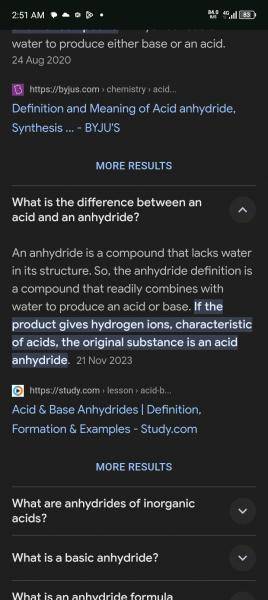
An anhydride are either acidic basic or inorganic so in this question they pointed out only one specific type of anhydride which is the characteristic of an acid anhydride so therefore option c has every reason to be correct
An anhydride also dissolve in water eg h2so4 . in essence all this reasons are contradicting to the fact that an acid anhydride loses all its water of crystallization and show in option a
@my school please correct this answer is C because an acid anhydride us an oxide of Non metal whose solution in water has a PH less than 7 because acid anhydride dissolves in water to form acid for example SO3 is the acid anhydride of sulfuric acid which dissolves the following ways
H2O+SO3..........H2SO4
H2O+CO2.......H2CO3
H2O+SO2......H2SO3
all this are acid anhydride of the following qcid which dissolves in water to form acid and remember acids have a PH less than 7 so the correct answer is C
option C is correct not A
Anhydride is oxide of non metal while anhydrous doesn't contain water
Anhydride: formed by removal of water from a substance
Andydrous : A substance without water of crystalization

the answer is C) cos anhydride are oxides of non metals which is Acidic with a PH less than 7
The correct answer from my research is option A, not all anhydride are acidic, nonmetalic oxides like SO2, CO2 are acidic anhydreide that dissolve and react in water to form an acid, while metallic oxides like MgO, Fe2O3 are basic anhydriedes which react with water to form a basic compound.
Check out more from here:
https://chem.libretexts.org/Courses/Sacramento_City_College/SCC%3A_CHEM_330_-_Adventures_in_Chemistry_%28Alviar-Agnew%29/07%3A_Acids_and_Bases/7.03%3A_Acidic_and_Basic_Anhydrides

