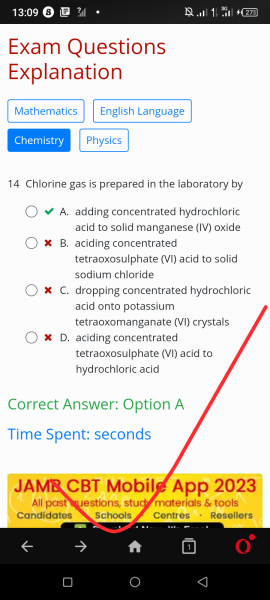
adding concentrated hydrochloric acid to solid manganese (IV) oxide
aciding concentrated tetraoxosulphate (VI) acid to solid sodium chloride
dropping concentrated hydrochloric acid onto potassium tetraoxomanganate (VI) crystals
aciding concentrated tetraoxosulphate (VI) acid to hydrochloric acid
Explanation
Video Explanation
Post your Contribution
Discussions (15)

Mr Admin.... Sorry for interruption, option A is not correct yet until "heating" is add to the statement.... Therefore option C is the correct answer because it occur in cold

C is wrong because kmn04 is potassium tetraoxomanganate vii not vi. That was put there to confuse us. Although A requires heat for the reaction to take place, it is still the only valid option.
Hint: Chlorine can be prepared in the laboratory by taking hydrochloric acid with oxide. The hydrochloric acid can be replaced with the salt of chloride and strong acid.
Complete step by step answer:
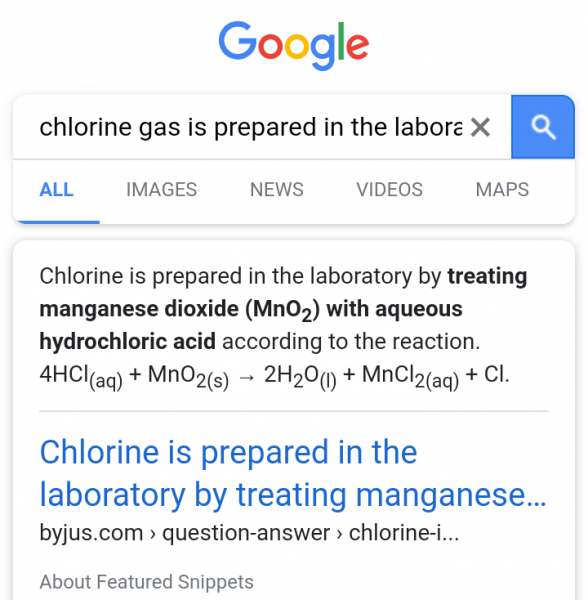
Chlorine can be prepared in the laboratory by taking conc. Hydrochloric acid with manganese dioxide.
The reaction of conc. Hydrochloric acid with manganese dioxide gives manganese di chloride, chlorine gas and water.
The reaction of conc. Hydrochloric acid with manganese dioxide is as follows:
MnO2 + HCl→MnCl2 + Cl2 + 2H2O
The most way common method of preparing chlorine gas in the laboratory is by using manganese dioxide to oxidize hydrochloric acid, as shown by this equation: The manganese dioxide is heated with concentrated HCl, and the gas produced is bubbled through water to remove any HCl gas present. OPTION A is legit
option A is not correct yet until "heating" is add to the statement.... Therefore option C is the correct answer because it occur in cold

C is incorrect because KMnO4 is potassium tetraoxomanganate(VII) not (VI) but would be correct if it was heating manganese(IV)oxide with conc. HCL. Nevertheless it is still the most correct option.



