positive change in entropy
negative entropy change
no entropy change
a minimum entropy change
Explanation
Video Explanation
Post your Contribution
Discussions (25)

Addition of sugar in tea leads to an increase in disorderliness because the sugar that was solid would melt there the disorderliness of the resulting solution would be greater than the former solution. So the answer is A.

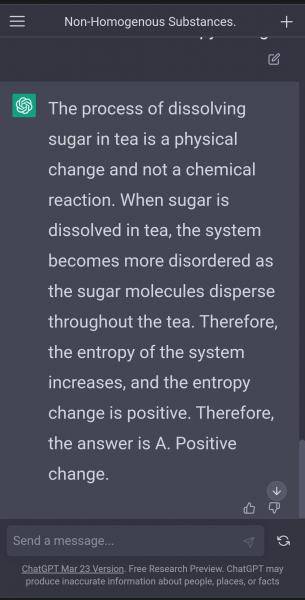

Since sugar spontaneously dissolves in water, the total entropy of water and sugar has to increase when sugar dissolves.

In the case of sugar dissolving in tea, the sugar molecules are becoming more dispersed as they dissolve. However, this increase in entropy is balanced by a decrease in entropy of the water molecules in the tea. The water molecules become more ordered as they form a "cage" around the sugar molecules through hydrogen bonding. This ordering of water molecules results in a decrease in entropy of the tea.
Since the increase in entropy of the sugar molecules is balanced by the decrease in entropy of the tea, there is effectively no net entropy change in the overall system. Therefore, the correct answer is Option C: no entropy change.


When sugar is dissolved in tea, the process is accompanied by a positive entropy change.
Entropy is a measure of the disorder or randomness of a system. When sugar dissolves in tea, the sugar molecules, which were originally in a relatively ordered crystalline state, become dispersed throughout the tea, resulting in a more disordered state. This increase in disorder corresponds to a positive change in entropy.
So, the correct answer is A. positive change. This is a fundamental concept in thermodynamics, which states that natural processes tend to move towards a state of greater disorder (or higher entropy).

The answer is C cus if sugar is dissolved in a tea it would sink to the Bottom and left undisturbed unless a spoon is used to mix. But since it wasn't disturbed there's no entropy change cus there's no disorderliness in the system.


