atoms can neither be created nor destroyed
the particles of the same element are exactly alike
particles of different elements combine in simple whole number ratio
all elemets are made of small indivisible particles
Explanation
Video Explanation
No video available
Post your Contribution
Discussions (43)

The honest truth is that none of these postulates hold anymore
Option A
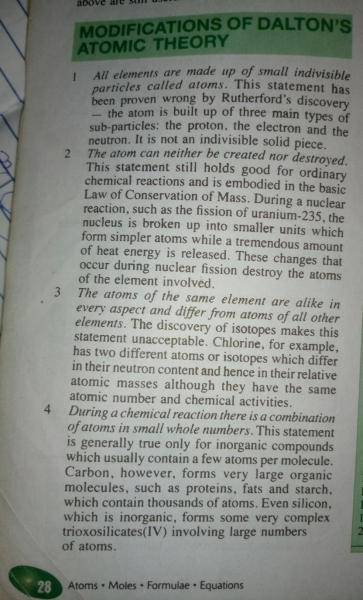
Atoms can neither be created nor destroyed.
During nuclear reactions such as nuclear fission atoms are destroyed and converted to energy
Option B
Atoms of the same element are exactly alike
This postulate has been invalidated by isotope, where an element can have the same atomic number but different mass number due to the difference in the number of neutrons. So not all atoms of the same element are alike because some of them might have a different number of neutrons.
Option C
Particles of different elements combine in a simple whole number ratio
This is true for most inorganic reactions, but not for organic compounds like carbohydrates which have thousands of molecules.
Option D
All elements are made of small indivisible particles called atoms.
As we already know, atoms are not indivisible and consist of other particles mainly electrons, protons and neutrons. So this postulate has been invalidated by the discovery of sub-atomic particles

A. atoms can neither be created nor destroyed..... is the right answer to the above question
Explanation:
Although the Dalton's atomic theory "A. atoms can neither be created nor destroyed" has been modified due to the production of proton, electron and neutron from the breakdown of an atom yet the above theory "still holds good for ordinary chemical reaction"
Also option C: particles of different elements combine in simple whole number ratio is generally true for inorganic compounds except organic compounds
However Option A still "holds"

the answer is A cos the existence of isotopes disapproves B,and C is also disapproved by some complex compounds like sugar(C12H22O11) and lastly the existence of proton,neutron and electron disapproves D

it's been proven by nuclear fission that atoms can be destroyed and they're divisible. You don't need a prophet to tell you the answer is C. if you think C is incorrect you must have forgotten the laws of chemical combinations.

I don't belive this answer..that answer has been proven wrong by scientists over the years..the correct answer is "A"

The answer is A. c is wrong because in some organic reaction,atoms do not combine in simple ratio but in large ratio e.g polymerization
U guys said dat is the answer but think about this " atoms" can neither be created nor destroyed have u forgotten during inspontaenous reaction atoms are broken down to form proton neutrons and electrons ... For example using carbonization which means the burning of coal in the absence of air so they the volatile components will be given off
When u burn coal the product formed is coal tar coal gar ammonial liquor which shows that matter or the atoms have dissociate or broken I believe from my own reasoning and understanding in chemistry dat atom could be destroyed to form lower particles


All the postulates have been proven wrong by scientista including option A but due to the law of conversation of mass that is still in use currently the correct answer is option A .

