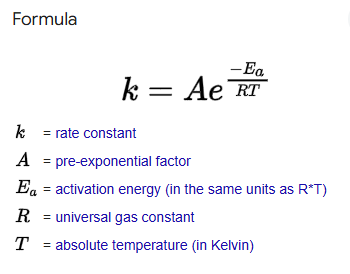
The Arrhenius equation expresses the relationship between the speed of a reaction and its
Molecular collision
Heat of reaction
Catalyst
Activation energy
Explanation
Video Explanation
No video available
Post your Contribution
Discussions (8)

Let R= rate of chemical reaction
From this
We know that
*Rate of chemical reaction is proportional to temperature*
I.e
R~T ..... Eqn 1
Also,,,
When rate of a chemical reaction increase,,, activation energy must have decrease. This is an inverse relationship
Mathematically
R~¹/Ae ..... Eqn 2
where Ae= activation energy
thus,, combining 1 and 2
We have
T
R~ ---- .... Eqn 3
Ea
Note... The only part that concerns Arrhenius theory is
Rate and activation energy which is eqn 2
Now,, the question said
The Arrhenius eqn expresses relationship between rate of reaction and
What?
Ans: activation energy
The reason is bcos,, in eqn 3,,, the variables are temp and activation energy
And the only part dat concerns Arrhenius is rate and temp..
If the question had said
"The rate of a chemical reaction depends on what?"
From the opts,The ansa wud b molecular collision (temp) and activation energy
But... Instead d question was strict by saying *in the Arrhenius equation rate depends on what?
Ansa is activation energy and not temperature (molecular collision)
Arrhenius equation: expresses the relationship between the rate constant and the activation energy of a reaction.
I think otherwise. Arrhenius equation has to do with the rate constant, frequency factor, activation energy and temperature amongst other things. although the catalyst reduces activation energy, the reaction shows the relationship with the activation energy and not the catalyst
I think otherwise. Arrhenius equation has to do with the rate constant, frequency factor, activation energy and temperature amongst other things. although the catalyst reduces activation energy, the reaction shows the relationship with the activation energy(D) and not the catalyst

