The conditions necessary for the extraction of a water molecule from two molecules of ethanol are
less acid and lower temperature
excess acid and a lower temperature
excess acid and a higher temperature
less acid and a higher temperature
Explanation
Video Explanation
Post your Contribution
Discussions (34)

The answer is supposed to be 'A'
Organic Chemistry
Incomplete dehydration of alkanol.
Less acid low temperature

bro
looking at this question
the condition necessary for the extraction of a water molecule from two Molecules of ethanol
isn't the answer A
because 2molecules of ethanol yield yield ethoxyethane with less acid and a lower temperature
but 1 molecule of ethanol yield ethene with excess acid and at a higher temperature
the question here is saying 2molecules of ethanol
bro correct me if i am wrong

The selected option is wrong.
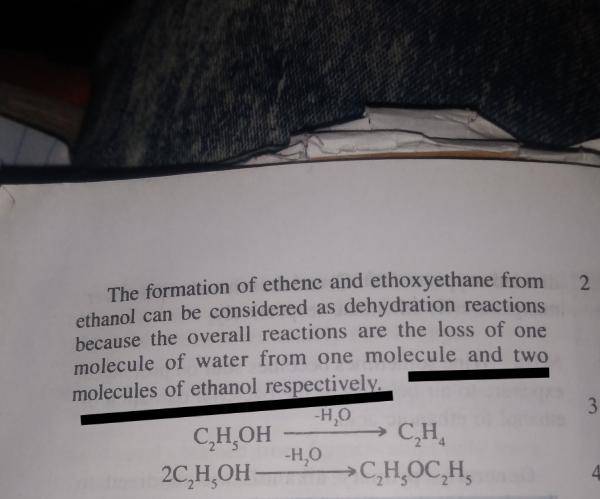
The process illustrated above is partial dehydration using conc. H2SO4 at 145oC to yield alkoxy alkane, hence the answer is excess acid and lower temperature C.

accolade to myschool, youre valid🦾 i swear i will stop looking at people's comment on here, i have made a lot of observation on here and i have come to conclusion that many dullard that commented on any question are the big f**ls here, before you comment and claim to be right about any question, you have to be sure of it, what pain me most is that, they will brag abiut there wrong answers and mislead alot of people on here, dehydration of one molecules of ethanol with sulphuric acid at high temperature and excess of sulphuric acid produce ethene and one molecules of water while
dehydration of two molecules of ethanol with sulphuric acid at low temperature and excess of ethanol produce one molecules of ethoxyethane and one molecules of water
so the similarity is that a mocules of water was produce
but the difference are the dehydration of one molecules of ethanol to produce ethene and one molecules of water at high temp and excess of the acid WHILE two molecules of ethanol to produce ethoxyethane and one molecules of water at low temp and excess of alkanol
The correct answer is B. excess acid and a lower temperature.
In the formation of diethyl ether from ethanol through dehydration, excess acid (e.g., concentrated sulfuric acid) and a lower temperature (around 140°C) are used to drive the reaction. Higher temperatures would favor the formation of ethylene instead of ether.

My school
Pls kindly correct the option above
In the presence of excess H2SO4 acid at a higher temperature, ethanol react to form ethene
And that is for one molecule of water to be dehydrated..it requires excess acid and high temperature
On the other hand, if the alkanol is in excess and lower temp. It yields ethoxyethane
That's for one molecule of water to be dehydrated from two molecules of alkanol and that's excess acid and lower temp.
Abeg o.......u guys stop causing confusion here and there

The correct answer is C) excess acid and a higher temperature.
The reaction you're referring to is the dehydration of ethanol to form diethyl ether or ethene, which involves the removal of a water molecule. This reaction typically requires:
1. *Excess acid*: A strong acid like sulfuric acid (H2SO4) or phosphoric acid (H3PO4) acts as a catalyst.
2. *Higher temperature*: Elevated temperatures facilitate the reaction, often around 140°C or higher.
Under these conditions, ethanol undergoes dehydration to form diethyl ether (at lower temperatures) or ethene (at higher temperatures).

Dehydration of Alcohols: Dehydration refers to the removal of a water molecule (H2O) from a molecule. In this case, we're dehydrating ethanol (C2H5OH) to produce ethene (C2H4) and water.
Role of Acid: An acid acts as a catalyst in this reaction, meaning it speeds up the reaction without being consumed itself. However, for the reaction to proceed efficiently, we need a sufficient amount of acid (excess acid).
Role of Temperature: Dehydration reactions are generally endothermic, meaning they absorb heat. Therefore, a higher temperature provides the activation energy needed for the reaction to occur at a faster rate.


The conditions necessary for the dehydration (removal of a water molecule) of two molecules of ethanol include:
1. Excess Acid:
- The presence of a strong acid, often sulfuric acid (H2SO4), provides protons (H+) for the reaction.
2. Higher Temperature:
- Elevated temperatures increase the kinetic energy of molecules, promoting the reaction.
This process is commonly used in industrial settings to produce ethene (C2H4) from ethanol (CH3CH2OH).
So the Vivacious guy above is correct.


