Agl > AgCl > AgBr
AgCl > Agl > AgBr
AgBr > AgCl > Agl
AgCl > AgBr > Agl
Explanation
Video Explanation
Post your Contribution
Discussions (34)

The selected answer is wrong:
AgCl , AgBr and AgI.When these substances are exposed to direct sunlight, they decompose completely to give a grayish substance (metallic silver) and emit electrons. However, in a dark cupboard they remain unchanged (i.e., no decomposition).
Their decomposition is dependent on the degree of light they are exposed to.
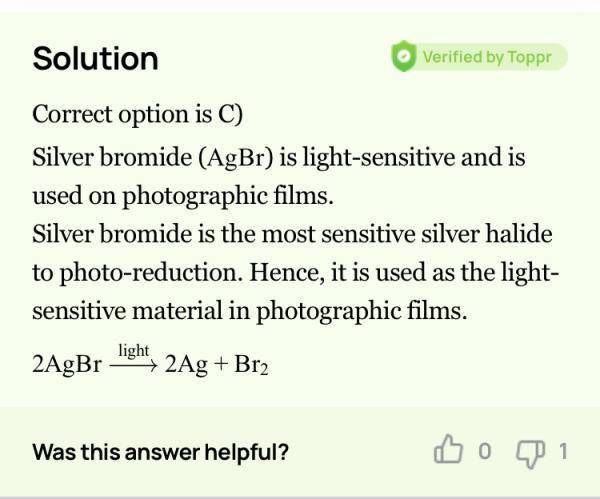
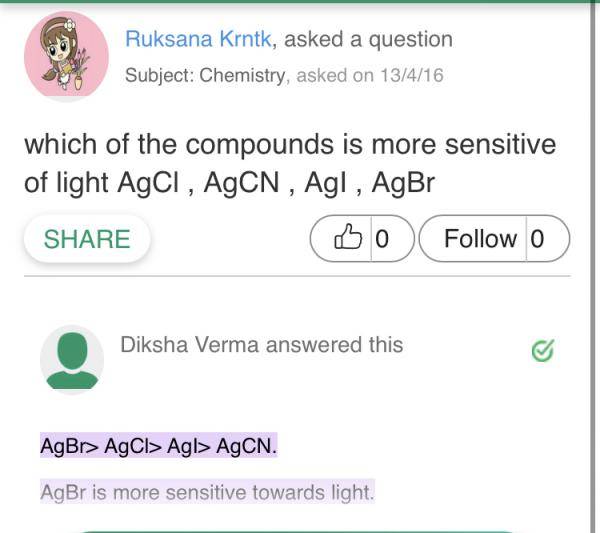
Note: comparing the light sensitivities of the silver halides, we have: AgBr > AgCl > AgI.
Due to the highest sensitivity of AgBr to light, it is used as the main compound suspended in the gelatin of a photographic plate.
REF: Google

use this eletronegative acroymn;
francis=F-
showed=SO3^2-
no=no^-
conscience=CL-
breaking=Br-
irene's=I-
odds=OH-
This question is very easy, it just requires simple reasoning and no long grammer...
we all know that, From the electrochemical series... chlorine is more reactive or rather more electronegative than bromine and iodine... the phrase "sensitive to light" simply means... which of them is more reactive/will become more energetic/ will readily give off electrons to silver(Ag) therefore, forming AgCl(Ag±Cl`)
in this case, AgCl>AgBr (i.e... more reactive than AgBr... moreover, AgBr>AgI
therefore, AgCl>AgBr>AgI
Please don't fight here's an explanation
Sure, here's an explanation:
The sensitivity of silver halide salts (AgX) to light depends on their respective halogens (X = Cl, Br, I).
1. **AgI (Silver Iodide)**: It is the most sensitive to light among the three because its crystal lattice structure allows for the easiest release of silver ions upon exposure to light.
2. **AgBr (Silver Bromide)**: It is less sensitive to light compared to AgI but more sensitive than AgCl. Its intermediate sensitivity is due to its crystal lattice structure, which allows for moderate release of silver ions upon exposure to light.
3. **AgCl (Silver Chloride)**: It is the least sensitive to light among the three because its crystal lattice structure tightly holds onto the silver ions, making it harder for them to be released upon exposure to light.
So, the correct order of sensitivity to light is AgBr > AgCl > AgI.
Silver salts are highly sensitive to light. Silver and other different halogens form different salts of silver. Mainly this is used for providing color to the photographic films.
i think @myschool answer is correct. pls no confusion thanks.
Well I just checked on google and it says sensitivity increases down the group and if we follow Josh's acronym from earlier the order would be
AgI>AgBr>AgCl

Please it's wrong.
The correct order is AgI > AgBr > AgCl.
The ability to decompose in the presence of light increases with decrease in bond strength just like in Br, and I.
My school is correct children of God🤧.
AgCl →least sensitive
AgBr→moderately sensitive
AgI→most sensitive.
Why?
As you go down the group(Cl→Br→I):
*atoms get larger
*bonds become weaker
*easier to break under light.
So, AgI=breaks fastest(most sensitive)
*then Br
*then Cl.
Increasing sensitivity is AgCl →AgBr→AgI.
phew🤧🥲 such a long text
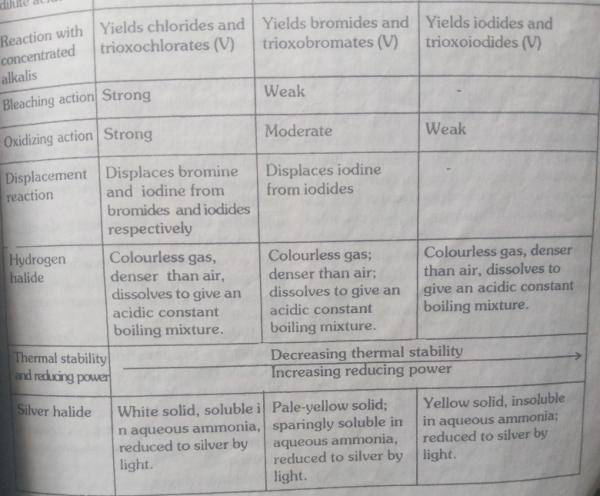
I really believe that you are wrong  because in the prescence of light, this reaction i believe will procede in a redox driven mechanism such that Ag+ gains electrons to produce metallic silver while Cl- looses its electron to atomize. Based on the series Cl- will readily atomize compared to Br- and I- finally to produce the grayish substance silver. Based on electro negativity status, AgCl will be most sensitive to light
 .
.

The order of light sensitivity for the given salts is **AgBr > AgCl > AgI**¹. Therefore, the correct answer is **Option C**.
This order is due to the fact that the light sensitivity of silver halides is related to their ionicity. Silver bromide (AgBr) is more ionic than silver chloride (AgCl), which in turn is more ionic than silver iodide (AgI). This makes AgBr the most sensitive to light, followed by AgCl, and then AgI.
These silver halides are often used in photographic materials due to their light sensitivity. For example, AgBr is widely used in photographic films.

