dissolve in alkalis
react violently with hydrogen without heating
are liquids
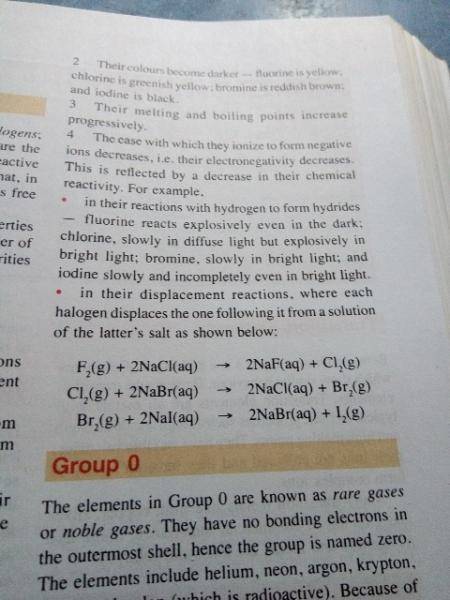
displace one another from solutions of their salts
Explanation
Video Explanation
No video available
Post your Contribution
Discussions (43)

The Ans Can't be D b/c chlorine can displace bromine,but bromine cannot displace chlorine so the don't displace one another.All,however,react with alkalis to form their respective trioxohalid.Ans =A

The Ans should be A cuz Chlorine can displace Br from its salt or solution, Br can displace I from it solution or salt while I cannot displace any of the elements(Br and Cl). but all the elements can dissolve in alkaline

i think d question is...hw do dey RESEMBLE each oda...it is nt exactly dere family reaction nd all dat..i tink wat dey all hv in common is dat dey all dissolve in alkali

Okay, let's figure out what these elements have in common!
* A. dissolve in alkalis: This is the best answer. All three elements react with alkaline solutions.
* B. react violently with hydrogen without heating: While chlorine does this, bromine and iodine need heat to react with hydrogen. So, it's not true for all of them.
* C. are liquids: Only bromine is a liquid at room temperature. Chlorine is a gas, and iodine is a solid.
* D. displace one another from solutions of their salts: While this is true, the best most encompassing answer from the list is that they dissolve in alkalis.
So, the correct answer is A. dissolve in alkalis.

chlorine bromine n iodine are all halogen which is d group 7 elements on d priodic table dey r also knw as "salt formers" and as u go down dis group reactivity of dis elements decrees therefor clorine is more reactive dan bromine thus it would diplace bromine in reaction of potassium bromide with clorine
Cl 2+ 2 KBr --------> kCl + Br 2
Thank you all for your contributions. The necessary correction has been effected. This question is really a controversial one, however, we will do justice to it accordingly.
Kindly note that Chlorine (Cl), Bromine (Br), and Iodine (I) resemble one another because they belong to the same group (Group VII) in the periodic table. As members of the same group, they share similar chemical properties due to the same number of electrons in their outermost energy level (valence shell). This results in similarities in their reactivity, electron configuration, and physical properties. Due to this, they have similar chemical reactions, such as reacting with metals to form salts.
Actually, the reason "they resemble one another because they displace one another from solutions of their salts" is a more specific and empirical reason. This reason highlights a specific chemical behavior that is common among the halogens, which is their ability to displace one another from solutions of their salts. This is a characteristic property of the halogens, and it's a more concrete and observable reason for their similarity.
Nonetheless, the ability to react violently with hydrogen without heating is the best reason when compared to others. The reason being that the property is a more specific and distinctive example of the halogens' reactivity, and it's a key characteristic that sets them apart from other elements, as the three of them (Chlorine, bromine and iodine) react vigorously with hydrogen gas to form hydrogen halides even without applying heat.
Based on these, the correct answer is option B - They resemble themselves because they react violently with hydrogen without heating.

@myschool, correct this
The Ans Can't be D b/c chlorine can displace bromine,but bromine cannot displace chlorine so the don't displace one another.All,however,react with alkalis to form their respective trioxohalid.Ans =A
@myschool, correct this
The Ans Can't be D b/c chlorine can displace bromine,but bromine cannot displace chlorine so the don't displace one another.All,however,react with alkalis to form their respective trioxohalid.Ans =A
Chlorine, bromine, and iodine resemble one another in that they:
A. Dissolve in alkalis
Explanation:
All three elements, chlorine (Cl2), bromine (Br2), and iodine (I2), are halogens and exhibit similar chemical properties. One of these properties is their ability to dissolve in alkalis, forming halides. This reaction produces halide ions (Cl-, Br-, I-) in solution. Therefore, option A is the correct answer.
This answer is wrong.
The correct answer should be (A). They dissolve in alkalis.
Displacement of a halogen from the salt of another halogen only occurs when the former is above the latter in the Group 7 (Halogen group). Therefore, option D is not fully correct. We, then, go for option A. Thank you.


