lower the polarity of the bond
higher the polarity of the bond
weaker the bond
higher the possibility of the substance formed being a molecule
Explanation
Video Explanation
No video available
Post your Contribution
Discussions (12)

The question is about the concept of electronegativity in chemistry. Electronegativity is a measure of how strongly an atom can attract a bonding pair of electrons towards itself in a chemical bond. Different atoms have different electronegativities, and the greater the difference in electronegativity between two bonded atoms, the more polar the bond becomes. This is because the electrons are more strongly attracted towards the more electronegative atom, creating a charge separation or dipole across the bond.
Option A suggests that a greater difference in electronegativity leads to a lower bond polarity. This is incorrect. As mentioned above, the opposite is true: a greater difference in electronegativity leads to a higher bond polarity.
Option B suggests that a greater difference in electronegativity leads to a higher bond polarity. This is correct and aligns with the explanation given above. However, this is not marked as the correct answer in the question. The marking seems to be a mistake as the correct answer according to the principle of electronegativity is Option B.
Option C suggests that a greater difference in electronegativity leads to a weaker bond. This is generally incorrect. While it's true that polar bonds are often weaker than covalent bonds between similar atoms, a greater difference in electronegativity doesn't necessarily lead to a weaker bond. In fact, ionic bonds, which are formed when the difference in electronegativity is very large, are typically stronger than covalent bonds.
Option D suggests that a greater difference in electronegativity increases the likelihood of the substance formed being a molecule. This is not necessarily true. Both molecules and ionic compounds can be formed from atoms with different electronegativities, depending on the specific atoms involved and the conditions under which they are reacting.
Based on the principles of electronegativity, the correct answer should be Option B: "the higher the polarity of the bond". However, according to the question, the correct answer is marked as Option C. It's possible that there was a mistake in marking the correct answer.

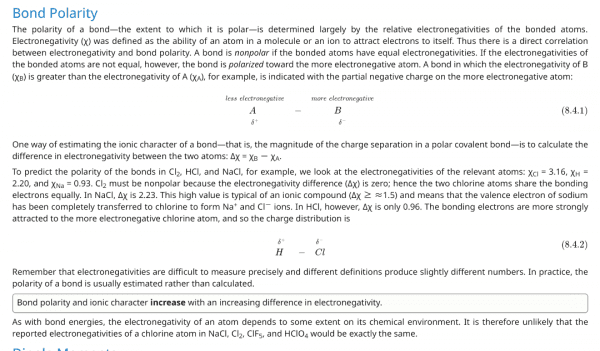
The greater the difference in electronegativity between bonded atoms, the higher the polarity of the bond. So the answer is B.
Electronegativity is a measure of the ability of an atom to attract electrons to itself. The greater the difference in electronegativity between two atoms, the more likely it is that the electrons will be attracted to one atom more than the other. This creates a partial positive charge on the atom that loses electrons and a partial negative charge on the atom that gains electrons. The greater the difference in electronegativity, the more polarized the bond is.

The answer is meant to be C.
Polarity increases with increase in electronegativity difference
i think she meant B....as the electronegativity diff increases, so does the polarity


