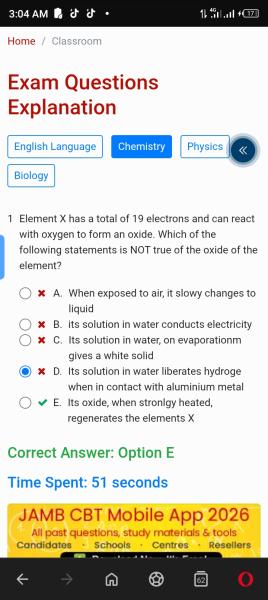
Element X has a total of 19 electrons and can react with oxygen to form an oxide. Which of the following statements is NOT true of the oxide of the element?
When exposed to air, it slowy changes to liquid
its solution in water conducts electricity
Its solution in water, on evaporationm gives a white solid
Its solution in water liberates hydroge when in contact with aluminium metal
Its oxide, when stronlgy heated, regenerates the elements X
Explanation
Video Explanation
No video available
Post your Contribution
Discussions (22)

the element x is potassium and its a metal wch can only form an oxide nd a metal can never form a liquid rather it will oxidise d liquid itself in order to form an oxide


The element with 19 electrons is Potassium¹. When it reacts with oxygen, it forms Potassium Oxide (K2O)⁷. Let's evaluate the statements:
A. When exposed to air, it slowly changes to liquid: **False**. Potassium Oxide is a solid and does not change to a liquid when exposed to air⁷⁹.
B. Its solution in water conducts electricity: **True**. Potassium Oxide is an ionic compound⁷. When dissolved in water, it forms an alkaline solution that can conduct electricity.
C. Its solution in water, on evaporation, gives a white solid: **True**. When the water in the solution evaporates, the remaining solid is Potassium Oxide⁷.
D. Its solution in water liberates hydrogen when in contact with aluminium metal: **True**. Alkali solutions like Potassium Oxide in water react with aluminium to produce hydrogen gas.
E. Its oxide, when strongly heated, regenerates the elements X: **True**. When heated, Potassium Oxide can decompose to form Potassium and Oxygen⁹.
So, the statement that is **not true** is **A**. Potassium Oxide does not change to a liquid when exposed to air.
Source: Conversation with Bing, 11/28/2023
(1) Potassium - Periodic Table. https://www.periodic-table.org/potassium-periodic-table/.
(2) Potassium Oxide - Structure, Properties, and Uses of K2O - BYJU'S. https://byjus.com/chemistry/potassium-oxide/.
(3) Potassium oxide - Wikipedia. https://en.wikipedia.org/wiki/Potassium_oxide.
(4) . https://bing.com/search?q=element+with+19+electrons.
(5) Protons Neutrons & Electrons of All Elements (List + Images). https://periodictableguide.com/protons-neutrons-and-electrons-of-elements/.
(6) Periodic Table - Ptable. https://ptable.com/?lang=en.
(7) Potassium - Atomic Number - K - Periodic Table of Elements. https://www.periodic-table.org/Potassium-atomic-number/.
(8) Potassium - Element information, properties and uses | Periodic Table. https://www.rsc.org/periodic-table/element/19/potassium.
(9) . https://bing.com/search?q=properties+of+potassium+oxide.
(10) Oxide of potassium, characteristics, properties and production .... https://sciencealpha.com/oxide-of-potassium-characteristics-properties-and-production-chemical-reactions/.
(11) Potassium Oxide - Introduction, Structure, Applications, Conclusion .... https://www.vedantu.com/chemistry/potassium-oxide.
(12) undefined. https://chem.libretexts.org/Courses/Heartland_Community_College/CHEM_120%3A_Fundamentals_of_Chemistry/02%3A_Atoms_and_Elements/2.04%3A_Neutrons%3A__Elemental_Isotopes_and_Mass_Number_Calculations.

The correct answer is **E. Its oxide, when strongly heated, regenerates the element X**.
Here’s why:
- **Element X** with 19 electrons is **potassium (K)**, which is in Group 1 of the periodic table.
- Potassium reacts with oxygen to form potassium oxide (K₂O).
- **Statement A**: Potassium oxide is hygroscopic and absorbs water from the air, forming potassium hydroxide (KOH), which is a liquid.
- **Statement B**: The solution of potassium oxide in water forms potassium hydroxide, which is a strong electrolyte and conducts electricity.
- **Statement C**: Evaporation of the potassium hydroxide solution leaves behind a white solid (KOH).
- **Statement D**: Potassium hydroxide reacts with aluminum to liberate hydrogen gas.
- **Statement E**: This is incorrect because potassium oxide (K₂O) does not decompose to form potassium metal when heated. Instead, it remains stable. Potassium metal is typically obtained through electrolysis, not by heating the oxide.
Thus, statement **E** is NOT true of the oxide of element X.

E.) is the correct answer cos the oxidation state of X is +1, hence its oxide is stable to heat

The answer should be d because a solution of potassium oxide in water forms and alkali. Alkalis dont react with metals to liberate hydrogen

K2O is the compound we are talking about
And it's deliquescent/hygroscopic
A is correct 👤👤

