A white solid suspected to be lead trioxonitrate (V) zinc trioxocarbonate (IV) or calcium trioxocabonate (IV) was heated strongly. Its residue which was yellow when hot and white when cold is?
lead (II) oxide
calcium oxide
zinc oxide
lead nitrate
Explanation
Video Explanation
No video available
Post your Contribution
Discussions (10)
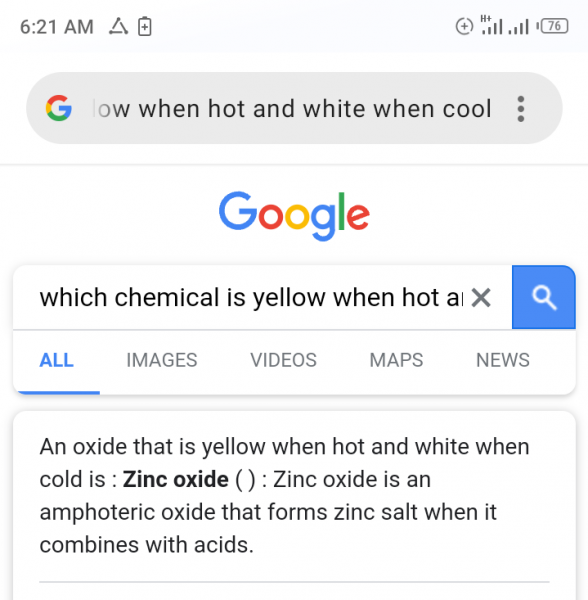

Zinc oxide is yellow in colour when it is hot and white in colour when it is cold.
The solid in question is suspected to be:
Lead trioxonitrate (V) – Pb(NO₃)₂
Zinc trioxocarbonate (IV) – ZnCO₃
Calcium trioxocarbonate (IV) – CaCO₃
When strongly heated (thermal decomposition):
Lead(II) nitrate, Pb(NO₃)₂ decomposes to:
2Pb(NO3)2→2PbO+4NO2+O
PbO (Lead(II) oxide) is yellow when hot and white when cold.
Zinc carbonate, ZnCO₃ decomposes to:
ZnCO3→ZnO+CO2
2.ZnO is yellow when hot and white when cold. (This seems like a possible answer, but lead(II) oxide is the better-known case.)
Calcium carbonate, CaCO₃, decomposes to:
𝐶𝑎𝐶𝑂3→𝐶𝑎𝑂+𝐶𝑂2
CaO remains white both hot and cold.
Conclusion:
Since the residue is yellow when hot and white when cold, the correct answer is Lead(II) oxide (PbO) from lead trioxonitrate(V) decomposition.
Final Answer: A. Lead (II) oxide


