A certain industrial process is represented by the chemical equation 2A(g) + B(g) \(\to\) C(g) + 3D(g) \(\Delta\)H = X kJmol-1. Which of the following conditions will favour the yield of the products?
increase in temperature, decrease in pressure
increase in temperature, increase in pressure
decrease in temperature,increase in pressure
decrease in temperature, decrease in pressure
constant in temperature, increase in pressure
Explanation
No explanation available
Video Explanation
No video available
Post your Contribution
Discussions (22)

I think the right answer to the question above is option D
Reason
1. Temperature is assumed constant since no temperature change was stated/indicated in the question.
2. In equilibrium, increase pressure will favour the side with the lower volume, and as such more of the products will be produced as required by the question.
Please, I would like to be notified when this is reviewed.
Thanks, Myschool representa

Pls, I need an explanation on why the answer should be D, because I don't think the question is complete
So...that means if it is + in invisible sign...that is
Increase in temperature, Decrease in pressure
While decrease in temperature, increase in pressure
the question tsef z nt complete cos dey ought to tel us d typ of rxn ts undergoing

Increase in pressure Will favour the the side with lower number of molecules.
In endothermic reaction increased in temperature will favour the product

the question is not complete because one can't determine if it is endothermic or exothermic
period!!🥵


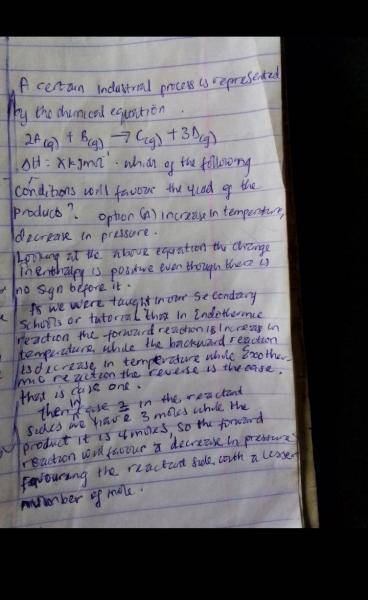

The selected option is correct coz it's an endothermic reaction, which is favored by increase in temperature ND decrease in pressure.

