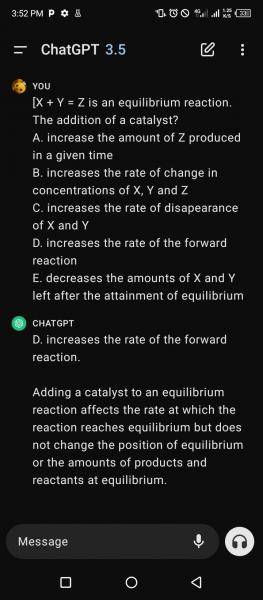
increase the amount of Z produced in a given time
increases the rate of change in concentrations of X, Y and Z
increases the rate of disapearance of X and Y
increases the rate of the forward reaction
decreases the amounts of X and Y left after the attainment of equilibrium
Explanation
No explanation available
Video Explanation
No video available
Post your Contribution
Discussions (17)

The correct answer is:
D. increases the rate of the forward reaction
Explanation:
A catalyst speeds up the forward and reverse reactions equally, without affecting the equilibrium constant (Kc). This means that the addition of a catalyst:
- Increases the rate of the forward reaction (X + Y → Z)
- Increases the rate of the reverse reaction (Z → X + Y)
The catalyst does not:
- Increase the amount of Z produced in a given time (A)
- Change the equilibrium concentrations of X, Y, and Z
- Decrease the amounts of X and Y left after attainment of equilibrium (E)
Options B and C are partially correct, but option D is the most accurate and direct answer.
myschool should make corrections

the answer should be A as catalyst do not affect quantity nor the equilibrium balance
The only role of a catalyst is to speed up the rate of chemical reaction, that is the rate at which the product is formed or the reactants. It doesn't affect the equilibrium position, its only role is to lower the activation energy of the reaction so that the rate of reaction can proceed at a faster rate, either backward or forward . They are not even concerned with the final amount of products.


Ref:Ababio chemistry
Catalyst doesn't change the position of equilibrium
But a positive catalyst increase the rate of both the forward and backward reaction by lowering the activation energy
it's true that a catalyst increases the rate of the forward reaction, it also increases the rate of the reverse reaction by the same amount. This means that although the reaction reaches equilibrium faster, the equilibrium concentrations of X, Y, and Z remain unchanged. Option D only highlights the forward reaction, whereas option B more completely describes the overall effect.
Therefore, the best answer is B – it increases the rate of change in concentrations of X, Y, and Z.


Aboyeji is right a positive catalyst increases the rate of both the forward and backward reactions to the same extent by lowering the activation energy of the reaction.

Dear my school team d is the answer
Do research if Paraadventure we are wrong please correct us if po a video may help