What weight of sodium hydroxide is required to make 500 cm\(^3\) of 0.2 M solution?
(Na = 23, O = 16, H = 1)
40 g
20 g
10 g
4 g
2 g
Explanation
Video Explanation
No video available
Post your Contribution
Discussions (16)


number of mole=CV
V=500cm^3 to dm^3
so therefore V=0.5
n=0.2×0.5
n=0.1
so therefore number of mole=0.1
number of mole=Mass/Molarmass
Molarmass=23+16+1
Molarmass=40
0.1=Mass/40
when u cross multiply
0.1×40=Mass
4=Mass
Also know as
Mass=4

2NaOH - H2O + Na2O
2 : 1 : 1
molar mass of 2(NaOH) = 80g
mole = Conc. * vol
Convert vol to dm^3
mole = 0.2*0.5 = 0.1
From the ratio
2 = 1
0.1 = x
cross multiply
x = 0.05
To find mass = mole* molar mass
0.05 = m/80
m = 4g
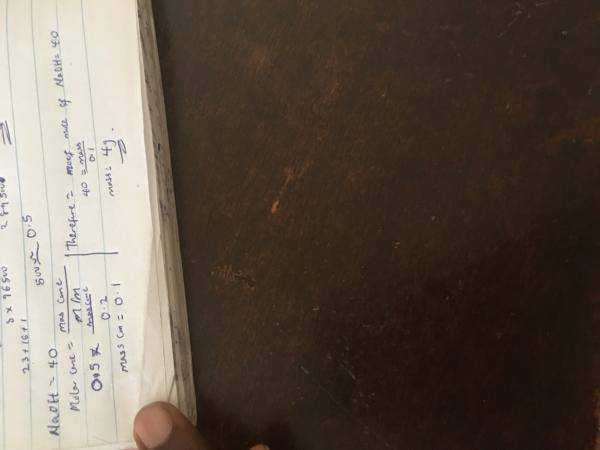
To find the weight of sodium hydroxide (NaOH) required, we need to calculate the number of moles needed and then multiply it by the molar mass.
Step 1: Calculate the number of moles
Molarity = moles / liter
0.2 M = moles / 0.5 L (since 500 cm³ = 0.5 L)
moles = 0.2 M x 0.5 L = 0.1 moles
Step 2: Calculate the molar mass of NaOH
Molar mass = Na (23) + O (16) + H (1) = 40 g/mol
Step 3: Calculate the weight required
Weight = moles x molar mass
Weight = 0.1 moles x 40 g/mol = 4 g
Therefore, 4 grams of sodium hydroxide is required.

m/mm = cv/1000
m= ?
mm of NaOH= 23+16+1
= 23+17 = 40
C=0.2
V = 500
m/40 = 0.2×500/1000
m/40 = 100/1000
CROSS MULTIPLY ✖️
1000m = 4000
m = 4000/1000
= 4g

