The scale formation in a kinetic used for boiling water is caused by the presence in water of?
calcium sulphate
calcium carbonate
calcium hydrogen carbonate
calcium hydroxide
magnesium sulphate
Explanation
Video Explanation
No video available
Post your Contribution
Discussions (12)

Myschool pls don't be confused
Calcium hydrogencarbonate is unstable when heated and decomposes to give solid calcium carbonate. This explains why temporary hardness is removed by boiling and the formation of 'scale' in kettles and boilers
So d correct and is opt B
The scale formation in a kettle used for boiling water is primarily caused by the presence of calcium hydrogen carbonate \((\text{Ca(HCO}_3)_2)\) in the water. When water containing calcium hydrogen carbonate is heated, it decomposes to form calcium carbonate \((\text{CaCO}_3)\), which precipitates out of the solution and forms scale.
The relevant reaction is:
\[ \text{Ca(HCO}_3)_2 \rightarrow \text{CaCO}_3 + \text{CO}_2 + \text{H}_2\text{O} \]
Thus, the correct answer is:
C. calcium hydrogen carbonate

When water containing dissolved calcium carbonate is heated, the carbonate ions combine with calcium ions to form insoluble calcium carbonate. This calcium carbonate then sticks to the surface of the kettle, forming a layer of scale.
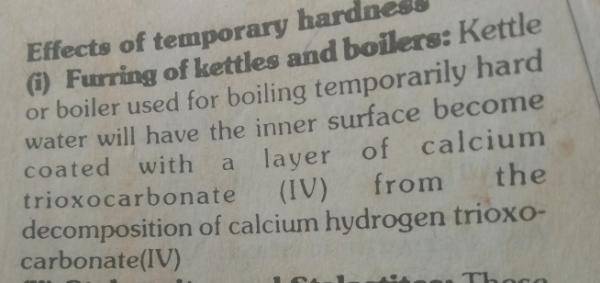


Temporary water is due to the presence of CaHCO3 which decompose into CaCO3 :-)... it's C

When water containing dissolved calcium carbonate is heated, the carbonate ions combine with calcium ions to form insoluble calcium carbonate. This calcium carbonate then sticks to the surface of the kettle, forming a layer of scale.
The answer is B.

