are extracted by reduction methods
form only basic oxides
show oxidation states of +2 and +3
form soluble hydroxides
Explanation
No explanation available
Video Explanation
No video available
Post your Contribution
Discussions (15)

the answer is correct because aluminium ore (bauxite) is first reduced to alumina before electrolysis occurs. iron too is extracted by reduction process. iron +2 and +3 hydroxides form green and brown precipitates respectively.


We will solve this by elimination method.
For options B 🚫
Aluminum can form both basic and acid oxide
For options C 🚫
Aluminum with atomic number 13 shows oxidation states of 3 and 5
Option D 🚫
Hydroxide of aluminum is insoluble
Hope I've been able to convince you and not to confuse you that the answer is A✅
@paschal gave the explanation well 😌
Wrong check chemistry ababio page 447 Al-electrolysis why Fe- Reduction by co2 or Roasting. I think the answer is d because but are solobule in steam

Paschal. Please check your facts clearly. Bauxite is actually the impure form of alumina which contains trioxosilicate impurities. So your explanation is very wrong.
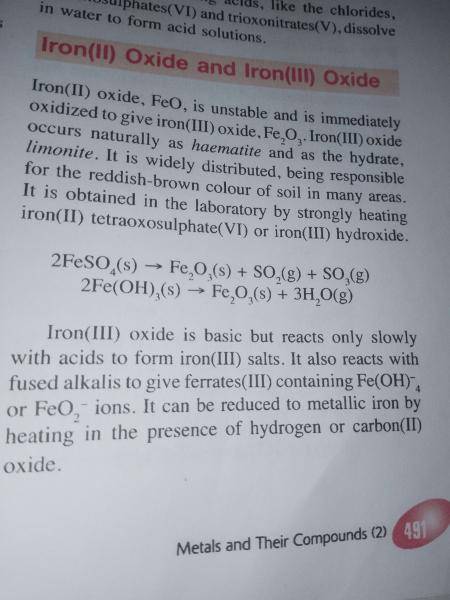
The correct answer is actually B(form only basic oxides). This is the reason why:
A is not correct as aluminum is extracted from bauxite by electrolysis, not by reduction.
C is clearly wrong as aluminum does not have a +2 state.
D is not correct, as the hydroxides of both aluminum and iron are insoluble. This is in fact the basis for the cation test using aqueous NaOH.
B is correct, as iron(III) oxide(being the stable oxide of iron) is weakly basic. The amphoteric nature of alumina means that it also reacts with acids, giving it basic character.
Thus, the correct answer is B(form only basic oxides). Thank you.

