A gas that will turn orange potassium heptaoxodichromate (lV) solution to clear green is?
sulphur (lV) oxide
hydrogen sulphide
sulphide (lV) oxide
hydrogen chloride
Explanation
No explanation available
Video Explanation
No video available
Post your Contribution
Discussions (15)

it is not sulphide iv oxide it is either sulphur iv oxide or hydrogen sulphide it is absolutely incorrect


It is H2s. Although So2 And H2s Are Reducing Agents, H2s Is A Stronger Reducing Agent Than So2. Therefore H2s Would Change Kmno4 To Green.

my school is correct ✅️✅️. recall H2S will give a yellow deposit of Sulphur while SO2 doesn't. 'clear green'
The correct answer is B. hydrogen sulphide.
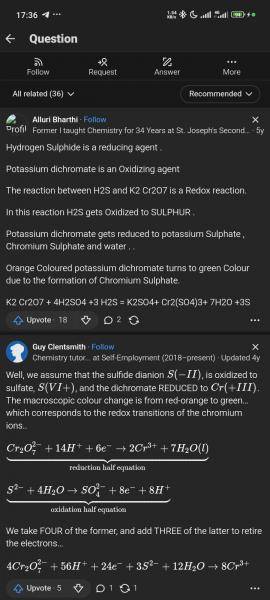
Potassium heptaoxodichromate (VI) solution, also known as potassium dichromate, is a strong oxidizing agent. When hydrogen sulphide (H2S) is added to this solution, it reduces the dichromate ions (Cr2O72-) to chromium (III) ions (Cr3+), which are green in color. This reaction is often used as a test for hydrogen sulphide.
The reaction is:
Cr2O72- (orange) + 3H2S → 2Cr3+ (green) + 3S + 7H2O
The other options do not cause the color change:
A. Sulphur (IV) oxide (SO2) will not reduce dichromate ions to chromium (III) ions.
C. Sulphide (IV) oxide is not a common term, but it's likely referring to SO2, which doesn't cause the color change.
D. Hydrogen chloride (HCl) is an acid that will not reduce dichromate ions to chromium (III) ions.
Great question!


I don't agree with my school
sometimes Sulphur (IV) oxide act as oxidizing agent in the presence of H2S as a reducing agent.
The answer is Hydrogen Sulphide "B". Reff. New school chemistry pg 196. please take correction myschool

