A gas that will turn orange potassium heptaoxodichromate (lV) solution to clear green is?
sulphur (ii) oxide
hydrogen sulphide
sulphide (lV) oxide
hydrogen chloride
Explanation
Video Explanation
No video available
Post your Contribution
Discussions (26)
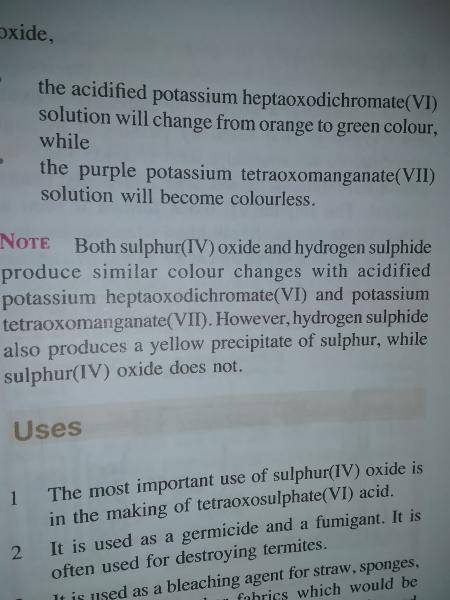

H2S gives the same result with SO2 when bubbled through acidified K2Cr2O7 with dilute H2SO4............but with H2S there will be a yellow deposit of sulphur
New school chemistry page177

there are two answers in the options.
Both sulphur (IV) oxide and hydrogen sulphide change the colour of that solution from orange to green

a reducing agent decolorizes an oxidation agent and Hydrogen sulphide is the reducing agent in the option so the answer is B
there is only one answer. The que says a clear green solution. Although, but H2S and SO2 will decolourize, only SO2 will give a clear solution as H2S give yellow deposits of sulphur at the bottom
the answer is surely SO2  H2S
H2S  The both will change the color to Green from orange. and i dont understand why 2 answers will be in the same question. check page 392 for SO2 and 389 for H2S. New school chemistry.
There are two answers to these questions because both hydrogen sulphide and sulphur (IV) oxide decolourize potassium tetraoxomanganate from orange to green.
Reference essential chemistry page 322 and 324
Potassium heptaoxodichromate (IV), commonly known as potassium dichromate (K₂Cr₂O₇), is an orange-colored oxidizing agent. When it reacts with a reducing agent, it is reduced to chromium (III) ion (Cr³⁺), which is green in color.
Hydrogen sulphide (H₂S) is a strong reducing agent. It reduces the orange dichromate (Cr₂O₇²⁻) ions to green Cr³⁺ ions, and in the process, the solution changes from orange to green.

