anode and a direct current is used
cathode and an alternating current is used
anode and an alternating current is used
cathode and a direct current is used
Explanation
Video Explanation
No video available
Post your Contribution
Discussions (13)




Electrolysis uses a direct current not an alternating current..d correct ansa shud b D

The correct answer is D. cathode and a direct current is used.
Here's why:
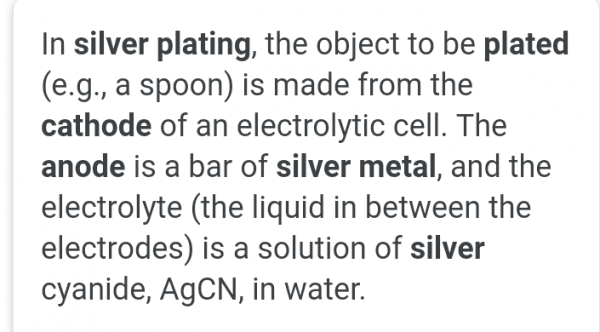
* Electroplating: Silver-plating is a type of electroplating, which uses an electric current to coat one metal with a thin layer of another metal.
* Cathode: In electroplating, the object you want to coat (metal M in this case) is connected to the negative terminal of the power source, making it the cathode.
* Anode: The metal that you want to use for coating (silver in this case) is connected to the positive terminal, making it the anode.
* Direct Current: Direct current (DC) flows in one direction, which is essential for electroplating. This ensures that the metal ions move from the anode to the cathode and deposit evenly on the object being plated.
How it works:
* Solution: The metal M (cathode) and the silver (anode) are immersed in a solution containing silver ions.
* Current: When a direct current is applied, the silver ions in the solution are attracted to the negatively charged metal M (cathode).
* Deposition: The silver ions gain electrons at the cathode and deposit as a thin layer of silver on the surface of metal M.

During electrolysis, it is a direct current that is passed through the electrolytes...

D is d correct ansa cos a direct current is passed into the set up of electroplating of metal M by placing it in cathode.

