NH\(_3\) + H\(_3\)O\(^+\) → NH\(_4\)\(^+\) + H\(_2\)O. It may be deduced from the reaction above that?
a redox reaction has occurred
H3O+ acts as an oxidizing agent
H3O+ acts as an acid
water acts as an acid
Explanation
Video Explanation
No video available
Post your Contribution
Discussions (20)

Option C is correct.
According to bronsted Lowry model of an acid. An acid is a proton donor.
In the above reaction, H3O+ donated a proton (I.e: H+ ) to NH3
Option C is correct.
According to bronsted Lowry model of an acid. An acid is a proton donor.
In the above reaction, H3O+ donated a proton (I.e: H+) to NH3.
I agree, but i feel option A wouldn't be wrong either. Since removal of hydrogen from H3O is oxidation, and addition of hydrogen to NH3 is reduction.
NH3 is a base while H30+ is an acid. so therefore H3O+ acts as an oxidizing agent.
H3O acts as an acid because it produces an ionic salt-NH4+ and water in the reaction.
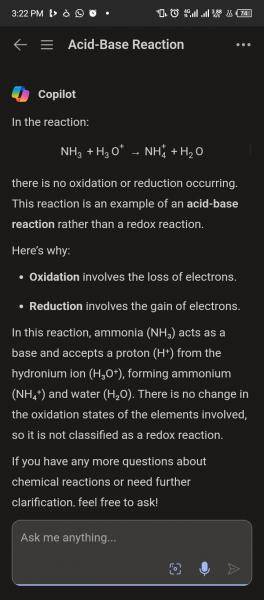

i feel an oxidatin rear hs occured cos hydrogen has been removed from H30 to NH3 to form NH4

Redox reaction simply involce electron transfer. that nullify option A