Which of the following statements is TRUE of the complete hydrolysis of a glycerine by sodium hygroxide?
3 moles ofNaOH are required for each mole of glyceride
3 moles of glycerol are produced
Only one mole of soap is formed
concentrated H2SO4 is essential for the completion of the reaction
Explanation
No explanation available
Video Explanation
No video available
Post your Contribution
Discussions (5)


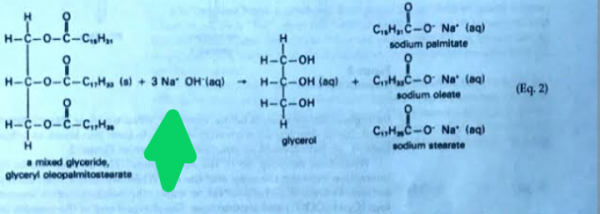
During the hydrolysis of a glyceride (a triglyceride), the ester bonds between the fatty acid chains and glycerol are broken by the action of a strong base like sodium hydroxide. This results in the formation of glycerol and the corresponding salts of fatty acids, which are commonly known as "soaps." The reaction can be represented by the following equation:
Triglyceride + 3 NaOH → 3 soap + glycerol
As per the equation, 3 moles of NaOH are required to hydrolyze one mole of glyceride, and 3 moles of soap and one mole of glycerol are produced. The use of concentrated sulfuric acid (H2SO4) is not essential for the completion of the reaction, but it can be used as a catalyst to speed up the reaction.
Thus option A is legit
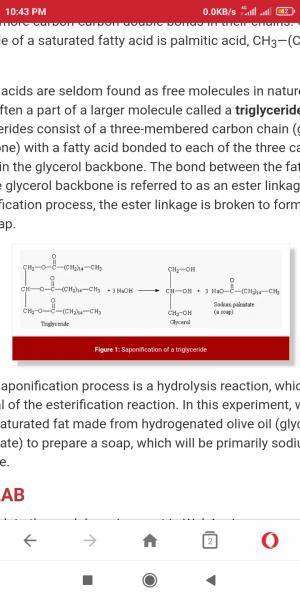
Soap is produced by the saponification (hydrolysis) of a triglyceride (fat or oil). (See Figure 1.) In this process the triglyceride is reacted with a strong base such as sodium or potassium hydroxide to produce glycerol and fatty acid salts. The salt of the fatty acid is called a soap.


