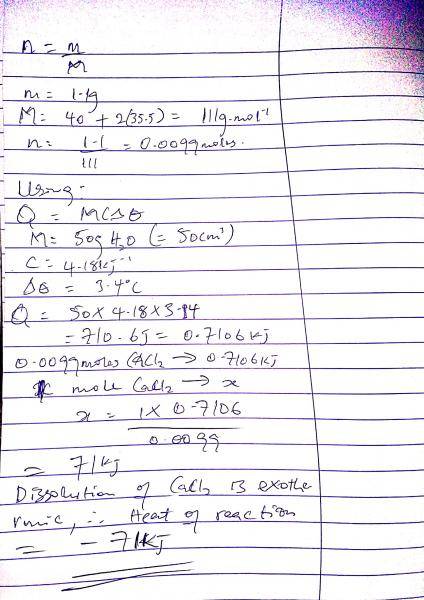
1.1 g of CaCI2 dissolved in 50 cm3 of water caused a rise in temperature of 3.4°C. The heat of reaction, ∆H for CaCI2 in kj per mole is?
(Ca = 40, CI = 35.5, specific heat of water is 4.18 jk-1)
-71.1
-4.18
+71.1
+111.0
Explanation
Video Explanation
No video available
Post your Contribution
Discussions (20)


Pov: the 9 year ago girl didn't come back to check her past self post😅(na me get time...lol

The statement "caused a rise in temperature" indicates that heat was given off to the surrounding which is a characteristic of exothermic reactions.

Goodday...
Pls again,I know it's last minute but pls🥹 Myschool is it possible to simplify most of your explanations.
And make them clearer like the spacing and all that.
Thank you so much, you're really trying.🤗

1.1 g of CaCI2 dissolved in 50 cm3 of water caused a rise in temperature of3.4°C. The heat of reaction, ∆H for CaCI2 in kj per mole is?


