The solubility of copper (II) tetraoxosulphate (Iv) is 75g in 100g of water at 100°C and 25g in 100g of water at 30°C. What mass of the salt would crystallize, if 50g of copper (II) tetraoxosulphate (VI) solution saturated at 100°C were cooled to 30°C ?
57.5
42.2
28.6
14.3
Explanation
Video Explanation
No video available
Post your Contribution
Discussions (21)

total Mass at 100degree
75+100 = 175g
Total mass at 30degree
25 + 100 = 125g
Mass crystalized for 175 cupper sulphate solution
175 - 125 = 50g
Mass for 50g solution of cupper sulphate solution
175g gave 50g crystals
50g will give Mg
Cross multiply
Mx175 = 50x50
M = 2500/175
M = 14.286g
D is correct ✍️👽
~Çlässíç!

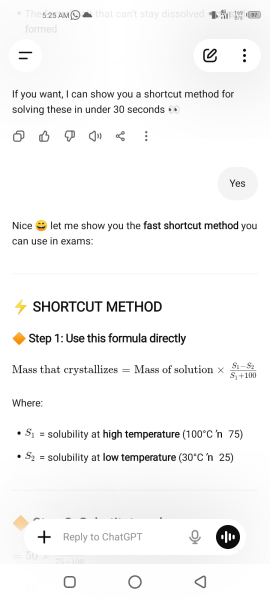

Sorry the calculated answer is correct but the composition of the question is wrong. 175g of solution should crystallise 75g of the crystal and not 50g as stated in the solution. It is cooling 100g 175g of solution at 100°C to 125g of solution to 30°C that will give 50g of the salt. I think saying that 175g of solution gives 50g of salt is wrong. It is even against the starting statement that solute + solvent = solution i.e 75g of solute + 100g of solvent = 175g.
Thanks
Let’s go through the explanation you got in the image and analyze where the mistake lies.
---
What they did in the image:
They assumed:
At 100°C: 75g CuSO₄ + 100g water = 175g solution
At 30°C: 25g CuSO₄ + 100g water = 125g solution
So, 175g solution at 100°C will crystallize 50g CuSO₄ when cooled to 30°C.
Then they took your actual case:
You have 50g CuSO₄ + 100g water = 150g solution? (but that’s not actually stated)
Then they applied a proportion:
\text{ppt} = \frac{50 \times 50}{175} = 14.3g
And chose D (14.3g) as the correct answer.
---
Where the mistake is:
1. Wrong assumption about solvent mass:
You were only told 50g CuSO₄ is saturated at 100°C, not that it was mixed with 100g water.
If 75g dissolves in 100g water, then 50g must be in less than 100g water.
2. They applied proportion using total solution mass (175g), but that's not valid unless you know the actual water mass used. In your case, we only know the solute (50g) and the solubility values.
3. Their method assumes the solution is made using 100g water, which contradicts the question. The question says "a solution containing 50g CuSO₄ saturated at 100°C," not "a solution made with 100g of water."
---
Correct Method Recap:
At 100°C, 75g CuSO₄ dissolves in 100g water.
So, 50g CuSO₄ must be in:
\frac{100}{75} \times 50 = 66.67g \text{ water}
At 30°C, 25g dissolves per 100g water.
So, in 66.67g water:
\frac{25}{100} \times 66.67 = 16.67g \text{ remains dissolved}
Therefore:
50 - 16.67 = \boxed{33.3g} \text{ will crystallize}
---
Conclusion:
The explanation in the image uses a faulty assumption about the amount of water (100g), and calculates based on total solution mass rather than actual solubility ratio. That’s why it gives 14.3g, which is incorrect.
The correct amount of salt that will crystallize is 33.3g.
Would you like me to create a visual note or shortcut formula you can memorize for these types?

The final answer according to the calculation is supposed to be 1.43g instead of 14.3g. The question is also wrongly composed. Saying 50g of tetraoxosulphate(VI) solution means that the mass of CuSO4 crystal and the mass of water smmed up gives 50g of solution. So the actual mass of the crystal in 50g of solution is unknown. Also the use of 175g only gives us a supposed correct answer any attempt to use 125g gives us another answer entirely. So the question is not well composed and that is why it may be difficult to solve the question. Thanks

