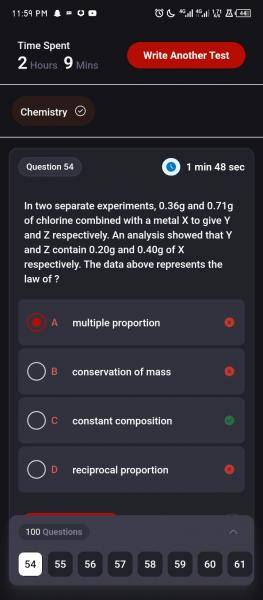
In two separate experiments, 0.36g and 0.71g of chlorine combined with a metal X to give Y and Z respectively. An analysis showed that Y and Z contain 0.20g and 0.40g of X respectively. The data above represents the law of ?
multiple proportion
conservation of mass
constant composition
reciprocal proportion
Explanation
Video Explanation
No video available
Post your Contribution
Discussions (21)

Mistake I mean it should be multiple proportion because they are in simple ratio
y'all should come let me clarify this.
you don't need to stress yourself for trying to know if it is constant composition or multiple proportion. The only thing you need to do is check if the composition of each of the elements in the both experiments are exactly the same thing. If their percentage in the two experiments are exactly same, listen I said exactly the same thing, JUST KNOW THAT it is constant or definite composition. But if the percentage VARIES, like they are not exactly the same thing, you will now know that it is multiple proportion that is being obeyed. So once you see a question like this, it can either be constant composition or multiple proportion depending IF IT'S exactly the same thing OR NOT.
So, like in this question now, find the total mass of the elements in experiment 1 and 2. In experiment 1, you have 0.36 grams of chlorine and the metal itself is 0.2. So add it up, it will give you 0.56. Then add experiment 2, add 0.71 and 0.4, It will give you total of 1.11.
Then, find the percentage of any of the elements in the compound.
(Let's use chlorine)
In experiment 1,
(0.36/ 0.56)×100/1~=64%
Experiment 2,
(0.71/1.11)×100/1=63.9~64.
So since both of them are exactly the same percentage, it's law of definite or constant composition .
Note: if not the same thing, then it's Multiple proportion.
please my school cross check this I was marked wrong while I was correct.